You're exhausted. You've been desperate for bed all day. Then your head hits the pillow and like a light flicking on your brain wakes up. It replays a conversation from three years ago, plans a holiday you're not taking, lists everything you forgot to do. So you reach for your phone to numb the noise, and look up to find it's 1am, then 2am, more wired and more tired than when you started.
If that's your night, please read this first: you are not lazy and you don't have bad willpower. You have a brain that finds it genuinely hard to switch off and that has real causes, and real fixes.
Here's why your brain won't settle at night, why it's got worse in your 40s, and what actually helps quiet it.
Why an ADHD brain won't switch off
For most people, night falls and the mind slowly quietens until it fades into sleep. For an ADHD brain, that "off switch" doesn't work the same way. The day's noise doesn't fade at bedtime often it gets louder.
There's a reason. An ADHD brain runs low on dopamine, the chemistry of focus and reward, so all day it quietly hunts for stimulation. When you finally lie down in a dark, quiet, under-stimulating room, your brain doesn't relax it goes looking for something interesting to chew on. Old conversations. Tomorrow's list. A worry from years ago. Anything to fill the silence.
So you're not lying awake because you're doing bedtime wrong. You're lying awake because a brain built to chase stimulation has finally been left alone with nothing to chase so it makes its own noise. That isn't indiscipline. It's wiring.
Wired but tired: why your body clock runs late
There's a second thing going on, and it explains the cruel "wired but tired" feeling: your body clock runs late.
Melatonin is the hormone that tells your body it's night. In many ADHD brains it's released significantly later than it "should" be for some people by a couple of hours. So at 11pm, when the world says sleep, your body hasn't had the signal yet. It genuinely doesn't feel like night to you. Then it hits at 1am or 2am, and suddenly you're exhausted, right when you can least afford to be.
This is why you can be shattered all evening and then weirdly alert at midnight. It's not a "second wind" you chose. It's a body clock that's shifted late, pulling your sleepiness back by hours. It also explains why mornings feel like being dragged out of deep water you finally fell asleep in the small hours, and now the alarm is going off in the middle of your night.
The night you don't want to give up
Here's the part almost no one admits: sometimes you're not lying awake you're staying awake. On purpose. Scrolling, tidying, watching one more episode, long after you're tired enough to sleep.
There's a name for it now: "revenge bedtime." It's what happens when the whole day belonged to everyone else work, children, the house, other people's needs. By the time night comes, you've not had one quiet, unclaimed moment that was yours. So some part of you refuses to give the day up. You steal the night back, because it's the only time that feels like your own.
That isn't weakness or self-sabotage. It's an exhausted woman taking the only freedom she can find even though it costs her the sleep she badly needs. And the answer isn't "have more discipline." It's to find pockets of your own time earlier in the day, so you don't have to steal them at midnight.
Why it's worse in perimenopause
If your sleep has fallen apart in your 40s, you're not imagining it and there's a reason.

Hi, I'm Laura
My ADHD was not recognised until perimenopause made everything impossible to ignore. I built ADHD in Women to give you the calm, clear support I wish I had earlier.
I know what it is to spend years coping, masking and quietly wondering why things got harder when they should have got easier.
For years, steady oestrogen and progesterone were quietly helping you sleep. Oestrogen supports the brain chemistry that steadies mood and focus; progesterone has a genuinely calming, sedative effect. Together they softened the edges of an already restless brain. Then perimenopause begins pulling both away, unevenly and unpredictably, and the sleep they were propping up starts to crumble.
On top of that come the night sweats, the 3am wake-ups, the sudden anxiety that arrives out of nowhere in the dark. Add them to a brain that already struggled to switch off, and you get the perfect storm: harder to fall asleep, harder to stay asleep, and far less reserve to cope with the broken nights. You didn't suddenly become bad at sleeping the hormones that used to carry you through are leaving, at exactly the moment life is asking the most of you.
What actually helps
You can't force sleep. But you can make room for it. A few things genuinely help:
- Wind down in stages. Don't go from a hundred miles an hour straight into a dark room. Give yourself a 3060 minute runway where the world gets slower, dimmer and less demanding the same gentle steps each night, so a reluctant brain learns the day is ending.
- Empty your brain onto paper. Half of what keeps you awake is your brain refusing to let go of things in case it forgets them. Keep a pad by the bed and write it all out before you lie down tasks, worries, stray thoughts. You're telling your brain: it's written down, you can stop holding it now.
- Dim the world an hour early. Bright light, especially from screens, tells your late body clock it's still daytime. Drop the big lights, use lamps, and turn your phone to its warmest, dimmest setting or better, charge it in another room.
- Bore yourself gently to sleep. A racing brain wants stimulation, so give it something just engaging enough to occupy it but far too dull to keep it awake: walk slowly through every room of a house you once lived in, or name an animal for each letter of the alphabet.
- Don't lie there fighting it. If you've been awake and wired for more than twenty minutes or so, get up. Go to another room, keep the lights low, do something calm and boring not your phone and go back when the heaviness comes. You're protecting the link between bed and sleep.
- Fix the morning, not just the night. Get daylight into your eyes soon after you wake, even ten minutes by a window. Morning light is the strongest signal for resetting a late body clock, nudging your melatonin to arrive earlier the next night.
- Be kind, not strict. Lying there furious with yourself is adrenaline, and adrenaline is the opposite of sleep. A broken night won't ruin you. Drop the pressure to sleep "perfectly" and, paradoxically, you make sleep more likely.
When to talk to your GP
Sleep problems are common with ADHD and with perimenopause, and some causes are very treatable so they're worth a conversation. It's worth booking an appointment if poor sleep is affecting your mood, health or ability to function; if you snore heavily, gasp, or wake unrefreshed however long you sleep (ask about sleep apnoea); if your legs feel restless at night; if you're in perimenopause (ask whether HRT, and progesterone in particular, might help); or if you suspect undiagnosed ADHD, because treating it can genuinely improve sleep. And please don't try to fix broken nights with alcohol or borrowed sleeping tablets both tend to make ADHD sleep worse over time.
Where to start
Could this be ADHD?
Take my free two-minute ADHD reflection test.
Is this me? Take the free testIf reading this felt like someone was finally describing your actual nights, the kindest next step is simply to understand your own pattern a little better and to stop calling yourself undisciplined for something you never chose.
A good place to begin is a free, private, two-minute reflection test that helps you see your pattern more clearly you can take it here. It won't diagnose you, but it will help you decide whether this is worth taking seriously.
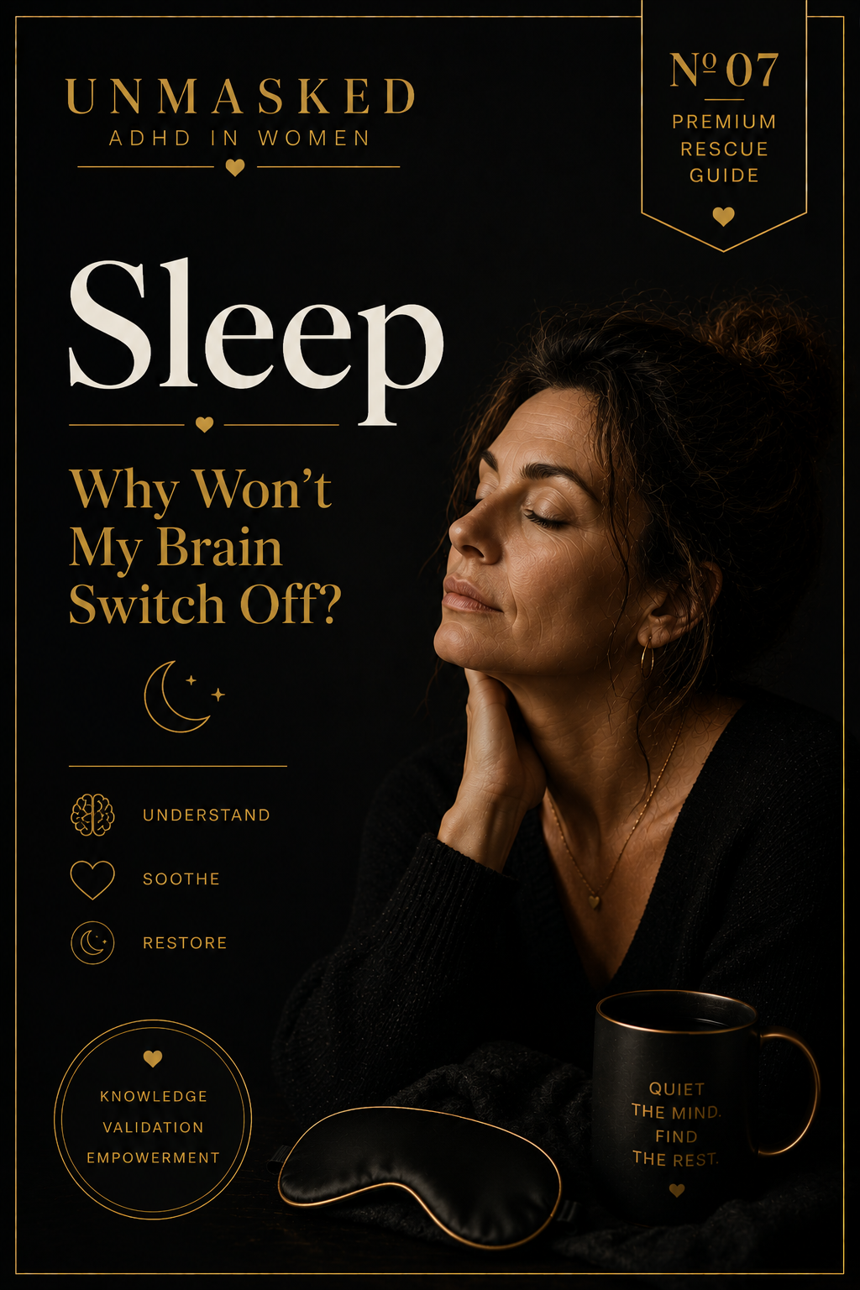
And if you'd like the whole picture why your brain won't settle, and exactly what to do when you're wide awake at 3am I wrote a complete companion guide called Why Won't My Brain Switch Off At Night? It goes far deeper than this article, with the wind-down tools, the shutdown routine, and a clear "how to talk to your GP" section. You can explore it here →
But whatever you do next, hold onto this: your brain isn't broken, and you were never lazy. You simply have a brain that finds it harder to stop than most people were ever taught to understand and now you know how to help it.
That understanding is where everything begins.
Written by Laura, founder of ADHD in Women. This article is for educational purposes only and is not intended to replace professional medical advice, diagnosis or treatment.
Part of The Unmasked Answers Collection a growing library of practical, premium guides helping women understand ADHD, perimenopause and menopause, one question at a time.