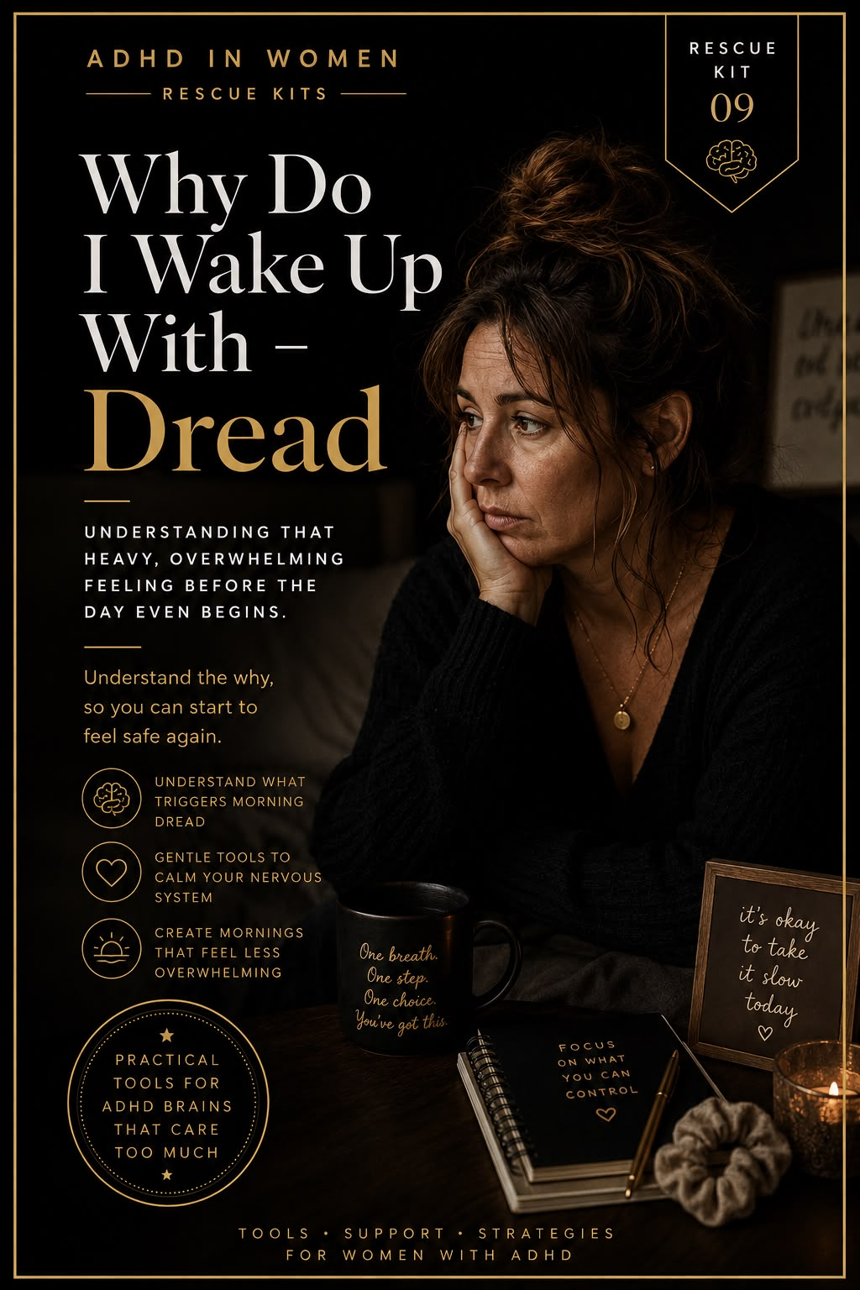
You open your eyes. Nothing has happened yet. You haven't checked your phone, you haven't remembered a single thing you're supposed to do and it's already there. A heavy, sick weight in your chest. A feeling that something is wrong, or about to go wrong. Dread, before the day has even started.
If you wake up like this most mornings and then lie there thinking "why do I feel like this, nothing is even wrong" please read this first: you are not being dramatic, and it is not "just stress." There is a real, physical reason your worst anxiety arrives first thing. It has a name, a cause, and things that genuinely help.
Here's what's actually happening, why it's so much worse in your 40s, and how to stop the dread from deciding your whole day.
The dread that's there before you are
Most people expect anxiety to build during the day, in response to something. For a lot of women, it's the opposite the anxiety is loudest in the first hour, when literally nothing has happened yet.
That's the part that makes you doubt yourself. If something had gone wrong, at least it would make sense. Instead you wake into a wall of "something's wrong," your mind immediately starts hunting for what, and within seconds it's found ten things to fasten onto that email, that conversation, that bill, that thing you said in 2019. The dread came first. Your brain just went looking for a reason to hang it on.
You're not waking up anxious because your life is a disaster. You're waking up anxious because your alarm system switches on before your reasoning does.
Why mornings, though? The cortisol part
There's a genuinely physical reason for this, and it's worth understanding because it takes the shame out of it.
Every morning, your body releases a surge of cortisol the alertness hormone to wake you up and get you going. It's called the cortisol awakening response, and it's completely normal. In a calm nervous system, it's just a gentle "up you get."
But if your nervous system already runs hot and ADHD brains, and stressed or trauma-shaped brains, very often do that morning cortisol surge doesn't land as "up you get." It lands as threat. Same hormone, oversensitive alarm. So you wake straight into fight-or-flight: racing heart, tight chest, that sick, urgent dread, before you've had a single thought. Your body sounded the alarm on schedule. There was just never any fire.
Why it's suddenly so much worse in midlife
If mornings have got heavier in your 40s, you are not imagining it, and you are not just "getting more anxious with age."
For years, steady oestrogen helped keep your stress chemistry balanced and softened the edges of that cortisol surge. It was quietly buffering you. Then perimenopause begins pulling the oestrogen away often unevenly, day to day and the buffer thins. The same morning surge that you used to ride now knocks you flat. On top of that, if ADHD went unnoticed for decades, you've likely spent your whole life running on adrenaline and last-minute pressure to get anything done. That's a nervous system that has been on high alert for a very long time. Midlife is often the point where the bill for that finally arrives.
So no you didn't suddenly become fragile. Your buffer came down at the exact moment your body was asking for more. That's hormones meeting neurology, and it deserves to be named, not judged.
The 3am version
For a lot of women it isn't only 7am it's 3am. You snap awake in the dark, heart going, brain instantly loud, running the worst-case version of everything. Then you can't get back to sleep, so you start the day already depleted, which makes the morning dread even worse. It's a horrible little loop.
That 3am wake-up is often the same alarm system firing in a dip of the night, made worse by falling hormones and a brain that never fully powers down. Knowing that won't switch it off overnight but it does mean you can stop treating 3am thoughts as the truth. Nothing decided at 3am is real. It's just the alarm, in the dark.

Hi, I'm Laura
My ADHD was not recognised until perimenopause made everything impossible to ignore. I built ADHD in Women to give you the calm, clear support I wish I had earlier.
I know what it is to spend years coping, masking and quietly wondering why things got harder when they should have got easier.
Three things to try before your feet hit the floor
You can't stop the cortisol surge it's meant to happen. But you can change what your brain and body do with it in the first few seconds. Start with these three:
- Don't reach for your phone. The dread is already scanning for threat; the phone hands it a hundred more. Give your nervous system the first few minutes before you feed it anything.
- Name it before you move. Say it silently: "This is the morning surge. It's chemistry, not a message." Naming it puts the smallest gap between you and the feeling and in that gap, you get a choice.
- Breathe out longer than you breathe in. A slow, long exhale is the fastest way to tell your body the alarm was a false one. Do it before you even sit up.
Those three take the edge off in the moment. But the thing that actually changes your mornings is having a set routine to reach for before the dread can take hold the same small steps, in the same order, every day, so your brain has a rail to hold instead of a cliff to face. That's exactly what I built into the guide: a simple first-ten-minutes routine to follow, plus scripts for the mornings you wake up unable to think straight. You don't have to design it yourself at 7am it's done for you.
Is it anxiety or something else?
Morning dread is real and treatable, and you don't have to white-knuckle it alone. It's worth gently talking to your GP partly because morning anxiety overlaps with low mood, thyroid issues and perimenopause, and partly because treating underlying ADHD, and sometimes reviewing hormones, can genuinely calm the whole system for a lot of women. You're allowed to ask for help with this. It is not too small to mention.
And please reach out sooner rather than later if the dread ever tips into not wanting to be here, or into panic you can't ride out. The morning can make everything feel unsurvivable it isn't, and the feeling will lift as the surge passes but you should never carry the worst mornings alone. Tell a trusted person, your GP, or in the UK the Samaritans on 116 123, any time of day or night.
Where to start
Could this be ADHD?
Take my free two-minute ADHD reflection test.
Is this me? Take the free testIf reading this felt like someone finally describing the thing you wake up into, the kindest next step is simply to understand your own pattern a little better and to stop calling yourself weak for something your own chemistry is doing to you.
A good place to begin is a free, private, two-minute reflection test that helps you see your pattern more clearly you can take it here. It won't diagnose you, but it will help you decide whether this is worth taking seriously.
And if you'd like the whole picture exactly what's happening at 3am and 7am, and a simple morning routine that calms the alarm before it runs your day I wrote a complete companion guide called Why Do I Wake Up With Dread? It goes far deeper than this article, with the in-the-moment tools, the printable pages, and a clear "how to talk to your GP" section. You can explore it here →
But whatever you do next, hold onto this: you are not broken for waking up afraid. Your alarm is just a little too loud, a little too early and that can be turned down.
That understanding is where everything begins.
Written by Laura, founder of ADHD in Women. This article is for educational purposes only and is not intended to replace professional medical advice, diagnosis or treatment. Anxiety can be a distressing subject; if you are struggling, please reach out to your GP or, in the UK, the Samaritans on 116 123.
Part of The Unmasked Answers Collection a growing library of practical, premium guides helping women understand ADHD, perimenopause and menopause, one question at a time.