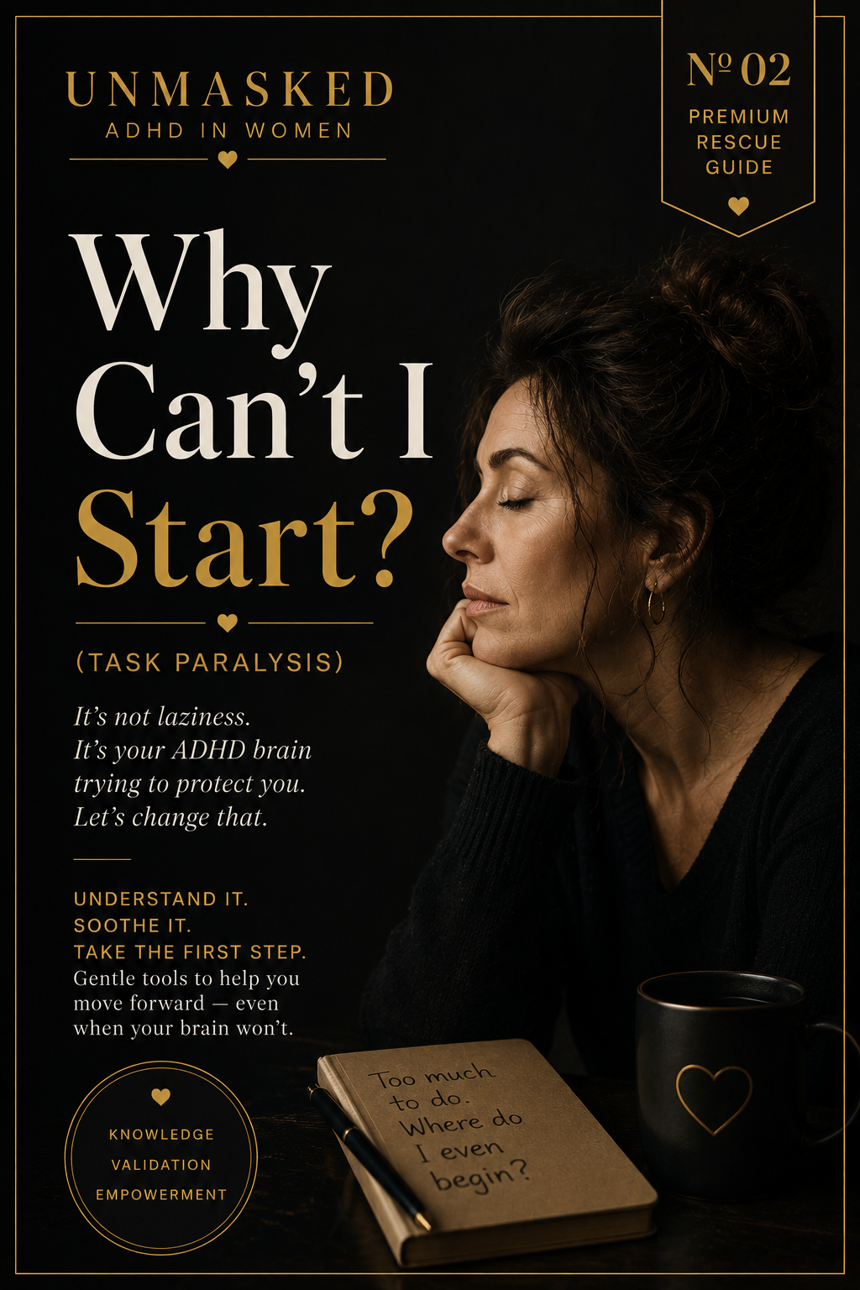
You sit down to do the thing. You know exactly what it is. You might even want to do it. And still nothing moves. The email stays unopened. The form stays blank. The dishes sit there while you sit here, scrolling, hating yourself, completely unable to begin.
If you've ever searched "why can't I make myself do anything," convinced you're just lazy or broken, please hear this first: you are not lazy, and you are not alone. What you're describing has a name. It's called task paralysis, and it is one of the most misunderstood, most shaming experiences an ADHD brain can have because from the outside it looks like doing nothing, and from the inside it feels like drowning while sitting perfectly still.
Here's what's actually happening, why willpower hasn't fixed it, and seven gentle ways to finally get moving.
What is ADHD task paralysis?
Task paralysis (sometimes called ADHD paralysis or executive dysfunction) is the experience of being mentally frozen unable to start, switch, or finish a task even when you genuinely want to and know exactly how.
The key thing to understand is that starting a task is not one single action. It's a hidden chain your brain has to fire in order: notice the task, decide to begin, work out the very first step, block out every other distraction, and push your body into motion. For most brains, that chain runs automatically. For an ADHD brain, any link can jam and when it jams, you freeze.
So you're not refusing to start. You're a car with the engine running and the gears stuck. Revving the engine harder trying harder, hating yourself more doesn't move you. Finding the jammed gear does.
Why "just wanting to" isn't enough
The cruellest myth about getting things done is that motivation comes first: if you just wanted it badly enough, you'd do it. For an ADHD brain, it works the other way around.
Most brains can run on importance this matters, so I'll do it. ADHD brains run on something different: interest, urgency, novelty, challenge. In a word, dopamine. If a task doesn't spark one of those, the brain struggles to release the chemical that powers the "go." You can want to with your whole heart and still have no fuel in the tank.
It's why you can clean the entire kitchen at midnight but not open one email at 10am. It was never about how much the task mattered. It's about whether your brain could generate the start. And willpower, frustratingly, cannot manufacture dopamine which is exactly why "just push through" has never worked for you.
Why the freeze is worst when it matters most
Here's something that makes no sense until someone explains it: the tasks you care about most are often the ones you can't start at all.
It feels backwards shouldn't caring make it easier? No. Because caring raises the stakes, and high stakes trigger the freeze. When a task really matters, your brain floods it with pressure: what if I get it wrong, what if it's not good enough, what if I start and fail. That pressure is overwhelm, and an overwhelmed nervous system doesn't push forward it shuts down.
Add perfectionism the quiet belief that it has to be done perfectly or not at all and starting becomes almost impossible, because "perfectly" is terrifying and "not at all" feels safe. This is why the important email sits for three weeks while you answer ten unimportant ones. The unimportant ones are safe to begin. The important one is guarded by fear.
The task isn't too hard. It's too loaded. And a loaded task can be defused.
It was never laziness it's a freeze
Let's say it plainly, because you've probably never been allowed to: what you experience is not laziness. It's a freeze response.
Laziness is comfortable. Task paralysis is agony. Lazy people don't lie awake hating themselves for what they didn't do. You do. You're not avoiding effort you're trapped behind a wall you can't see, trying to climb it with tools no one ever gave you.
When you can't start, your brain has hit overwhelm and flipped into protection mode the same freeze a body does in danger. That dread, that fog, that heavy stuck feeling: it's a stress response, not a character flaw. And this isn't a comforting story invented to let you off the hook clinicians who work with ADHD describe this exact state. What looks like procrastination is often the brain mounting a stress response to an ordinary task.

Hi, I'm Laura
My ADHD was not recognised until perimenopause made everything impossible to ignore. I built ADHD in Women to give you the calm, clear support I wish I had earlier.
I know what it is to spend years coping, masking and quietly wondering why things got harder when they should have got easier.
So every time you've called yourself lazy, useless or broken, you've been blaming yourself for a nervous-system response you never chose.
How to actually start: seven gentle ways to thaw a freeze
You can't force your way out of a freeze but you can thaw one. These are the tools that work with an ADHD brain instead of against it.
- The five-minute start. Tell yourself you only have to do the task for five minutes, then you're genuinely allowed to stop. Your brain isn't afraid of five minutes it's afraid of the whole mountain. Five minutes shrinks the mountain to a single step, and nine times out of ten you'll keep going, because the freeze breaks the moment you move.
- Shrink it until it's stupid. Not "do the tax return" ? "open the folder." Not "clean the kitchen" ? "put one cup in the sink." Make the first step so small it feels almost silly. You're not lowering your standards; you're giving your brain a door it can actually walk through.
- Move your body first. Freeze is physical, so break it physically. Stand up, shake out your hands, walk to another room and back. A frozen body keeps a frozen brain move the body, and the door often opens on its own.
- Do it badly on purpose. For the perfectionist freeze, the cure is permission to be terrible. Aim for the ugliest first draft. A bad start can be fixed; a blank page can't.
- Don't start alone. ADHD brains often begin far more easily when another person is simply present a friend on a video call, someone in the same room, even a text that says "starting now." It's called body doubling, and needing it isn't weakness, it's strategy.
- Build a launch sequence. Pilots don't rely on willpower to take off they run a checklist. A short, same-every-time routine (clear the space, water, timer, one breath, tiny first step) tells your brain "we're starting now" before the resistance kicks in.
- Ease the switch. Often the freeze isn't about the task at all it's about the switch from one thing to another. Give yourself a buffer between tasks and have your first tiny step ready and waiting, so there's no empty gap to freeze in.
None of these require more willpower. They just give your brain a way in.
When it might be more than task paralysis
Task paralysis and low mood can look very similar, and sometimes they overlap. It's worth gently talking to your GP if you've lost interest in almost everything (not just hard tasks), if you feel persistently low, hopeless or exhausted beyond ordinary tiredness, if you can't start even the things you normally enjoy, or if daily life is genuinely slipping and getting heavier rather than lighter.
Could this be ADHD?
Take my free two-minute ADHD reflection test.
Is this me? Take the free testThis isn't about labels it's about getting the right support. Task paralysis responds to the tools above; depression and burnout sometimes need more, and asking for help is brave, not dramatic.
Where to start
If reading this felt like someone was finally describing your day, the kindest next step is simply to understand yourself a little better.
A good place to begin is a free, private, two-minute reflection test that helps you see your own pattern more clearly you can take it here. It won't diagnose you, but it'll help you decide whether this is worth taking seriously.
And if this article felt like someone was finally describing your life, I wrote a complete companion guide called Why Can't I Make Myself Do Anything? It goes much deeper than this article and includes practical exercises, worksheets and calming tools to help you stop blaming yourself and actually start. You can explore it here →
But whatever you do next, hold onto this: you were never lazy. You were frozen and a freeze can always be thawed. You just needed someone to hand you the warmth instead of more force.
Written by Laura, founder of ADHD in Women. This article is for educational purposes only and is not intended to replace professional medical advice, diagnosis or treatment.
Part of The Unmasked Answers Collection a growing library of practical, premium guides helping women understand ADHD, perimenopause and menopause, one question at a time.