Someone sends a short reply. A friend doesn't text back. Your boss says "can we have a quick chat." And the floor drops out from under you. Not mild worry a physical blow. Shame, panic, a hot wave of they're done with me, and hours or days you can't claw back.
If a small rejection can flatten you completely and then you stand there thinking "why am I like this, why can't I just let it go" please read this first: you are not too sensitive, and you are not broken. You're very likely feeling something called rejection sensitive dysphoria. It has a name, a cause, and tools that actually help.
Here's what it is, why it feels so physical, why it's suddenly worse in your 40s, and how to start riding the wave instead of drowning in it.
What is rejection sensitive dysphoria (RSD)?
Rejection sensitive dysphoria is extreme emotional pain triggered by rejection, criticism, or even the sense that someone is disappointed in you. "Dysphoria" is Greek for "unbearable" and that's the honest word for it. This isn't feeling a bit hurt. It's a sudden, crushing wave that can feel like grief, panic or physical injury, all at once.
It's one of the most common and least talked about parts of ADHD in women. And the cruellest part is how small the trigger can be: a tone in a message, being left out of something minor, a piece of feedback that was mostly positive. Your reaction feels wildly out of proportion, so on top of the pain comes a second layer shame at reacting "too much." You're not overreacting on purpose. Your brain is sounding a fire alarm over a piece of toast.
Why it feels physical not just emotional
Here's the part that changes everything once you understand it: with RSD, the pain lands before you can think.
In an ADHD brain, the emotional alarm system fires fast and loud, and the calm, reasoning part arrives late to the scene. So a rejection doesn't start as a thought you can argue with it starts as a full-body event. A dropping stomach. A tight chest. Heat up the neck. That's why "just don't take it so personally" is useless advice: by the time you could think it through, the wave has already hit.
So please stop asking why you can't reason your way out of it. You can't think your way out of a feeling that arrives before thinking does. That isn't weakness. It's wiring and knowing that is the first crack of light.
The whole life built to avoid the wave
Once you see RSD, you start to see how much of your life quietly bent around avoiding it.
The people-pleasing. The over-apologising. Saying yes when you're already drowning. Rehearsing a text sixteen times before you send it. Avoiding the risk, the ask, the difficult conversation not because you're weak, but because some part of you learned that rejection hurts too much to survive, so you organise everything to never feel it. Many women recognise themselves instantly as a pleaser (keep everyone happy), a perfectionist (be flawless so there's nothing to reject), or a withdrawer (leave before you're left).
None of that is a character flaw. It's armour you built, very young, against a pain you had no name for. It kept you safe. It also cost you an enormous amount and you're allowed to start putting some of it down.
Why rejection cuts deeper in midlife
If the waves have got worse in your 40s, you're not imagining it and there's a reason.
For years, steady oestrogen helped your brain make and use dopamine and serotonin, the chemistry that steadies mood and softens the edges of a hard moment. It was quietly buffering you. Then perimenopause begins pulling that oestrogen away, and the buffer thins. Same brain, same wiring but far less of the chemistry that used to help you ride the wave. So feelings that once knocked you sideways now knock you flat.

Hi, I'm Laura
My ADHD was not recognised until perimenopause made everything impossible to ignore. I built ADHD in Women to give you the calm, clear support I wish I had earlier.
I know what it is to spend years coping, masking and quietly wondering why things got harder when they should have got easier.
You didn't suddenly become fragile or "too much" in midlife. The scaffolding that held you steady is coming down, at the exact moment life is asking the most of you. That's not a failing. It's hormones meeting neurology and it's worth naming out loud.
What actually helps in the wave
You can't stop RSD from firing. But you can change what happens next. A few things genuinely help:
- Name it. The second the floor drops, say it silently: "This is RSD. It's a wave, not the truth." Naming it puts the smallest gap between you and the pain and in that gap, you get a choice.
- Do nothing in the storm. No replies, no decisions, no confronting, no quitting. The wave will scream at you to act right now. Don't. You can act later, once it lifts and it always lifts.
- Soothe your body first, not your thoughts. Breathe out slowly, longer than you breathe in. Feet on the floor, a warm drink, a walk. Calm the alarm before you try to reason reasoning comes back online once the body settles. (Please skip anything that uses pain or shock to cope; you're calming the alarm, not punishing yourself.)
- Fact-check the story. The wave deals in always and never "everyone's sick of me," "I've ruined it." Ask gently: what actually happened? Usually it's one short reply, nothing more.
- Say it to a safe person. Spoken aloud to someone kind, the wave shrinks. "I know this is probably RSD, but I feel like I've upset you" lets reality back in.
- Feel it without obeying it. You can let the wave move through you cry, shake, sit with it without sending the message or believing the story. The feeling is real. What it's telling you is not.
Is it RSD or something else?
RSD isn't a formal diagnosis on its own, but it's widely recognised as part of ADHD, and you don't have to manage it alone. It's worth gently talking to your GP or a professional especially because it overlaps so closely with anxiety and low mood, and because treating underlying ADHD (and sometimes reviewing hormones in perimenopause) can genuinely soften the waves for many women.
And please reach out sooner rather than later if the pain ever tips into feeling you don't want to be here. RSD can make a passing rejection feel unsurvivable it isn't, and the feeling will pass but you should never ride the worst waves alone. Tell a trusted person, your GP, or in the UK the Samaritans on 116 123, any time.
Where to start
Could this be ADHD?
Take my free two-minute ADHD reflection test.
Is this me? Take the free testIf reading this felt like someone was finally describing what happens inside you, the kindest next step is simply to understand your own pattern a little better and to stop calling yourself "too sensitive" for something you never chose.
A good place to begin is a free, private, two-minute reflection test that helps you see your pattern more clearly you can take it here. It won't diagnose you, but it will help you decide whether this is worth taking seriously.
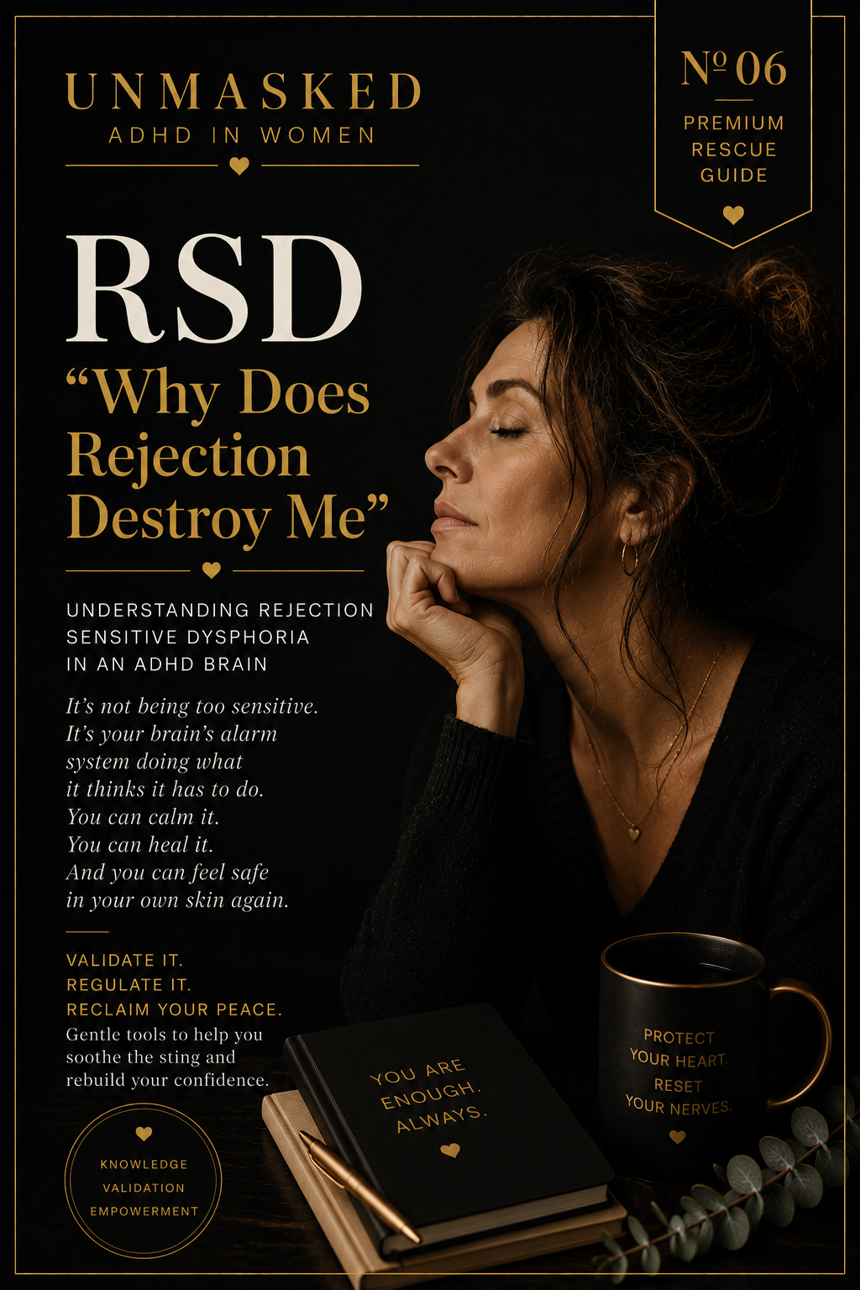
And if you'd like the whole picture why rejection lands like a physical blow, and exactly what to do when the wave hits I wrote a complete companion guide called Why Does Rejection Destroy Me? It goes far deeper than this article, with the exercises, the in-the-moment tools, and a clear "how to talk to your GP" section. You can explore it here →
But whatever you do next, hold onto this: you were never too much, and you were never too sensitive. You feel deeply that was never the problem and now you're learning how to stay standing in the wave.
That understanding is where everything begins.
Written by Laura, founder of ADHD in Women. This article is for educational purposes only and is not intended to replace professional medical advice, diagnosis or treatment. Rejection sensitivity can be a distressing subject; if you are struggling, please reach out to your GP or, in the UK, the Samaritans on 116 123.
Part of The Unmasked Answers Collection a growing library of practical, premium guides helping women understand ADHD, perimenopause and menopause, one question at a time.