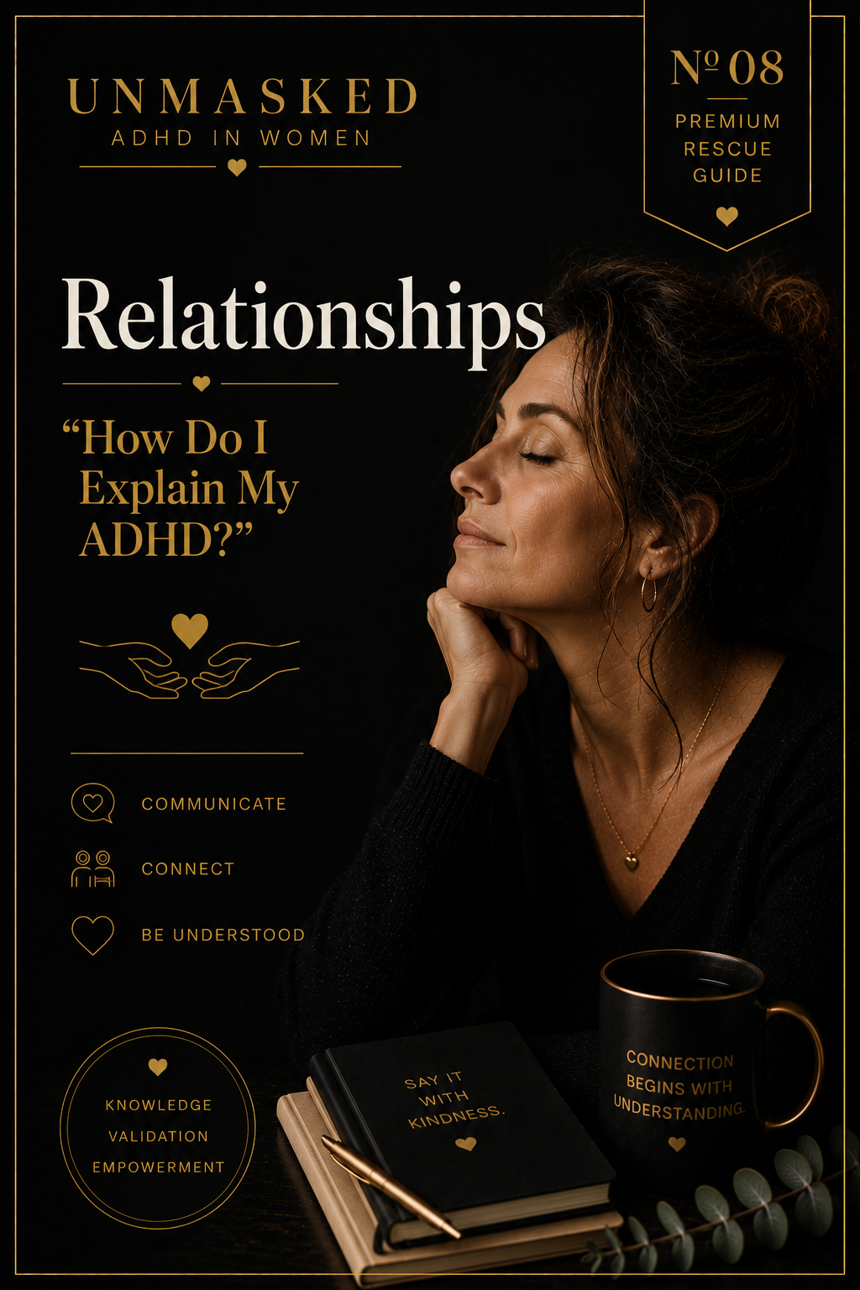
You snap at your partner over nothing. You lose patience with your children, then lie awake sick with guilt. You forget the thing that mattered to someone and watch their face fall. And you can't understand why you keep hurting the people you love most the very people you'd do anything for.
If that's you, please read this first: it isn't that you love them less, and it isn't that you're simply a bad partner, mother or friend. It's what happens when an ADHD brain overwhelmed, dysregulated, running on empty spills over onto the nearest, safest people. And once you understand it, you can explain it, and you can repair it.
Here's why your ADHD lands hardest on the people closest to you, and how to help them understand.
Why it spills onto the people you love
All day, you hold it together for work, for strangers, for people you can't let see the struggle. You mask, you manage, you swallow the overwhelm. It takes everything you have. And by the time you get home, to the people who love you, there's nothing left to hold it in with.
So it spills. The snap, the sharp tone, the going cold, the tears from nowhere. Not because you love them less but because they are the one place you finally feel safe enough to stop performing. Home is where the mask comes off, and sometimes what's underneath is raw.
This is the truth no one explains: you don't hurt the people you love because you care about them least. You hurt them because they're the safest place you have the only people you trust enough to fall apart in front of. It's a backhanded kind of love, and it still causes real pain, but it is not proof that you're a bad person.
Why you snap and can't stop in time
An ADHD brain feels emotions faster and bigger than most, and regulates them more slowly. So when you're tired, overstimulated or overwhelmed, irritation doesn't build gradually with time to catch it it arrives all at once, full volume, before the calm part of your brain can get a word in.
That's why you snap and instantly regret it. It isn't that you didn't try to hold it in; it's that the feeling crossed the line before you had the chance. Add rejection sensitivity where a small criticism or change in tone lands like a physical blow and you can flare or withdraw over something that looked tiny from the outside. To them it came from nowhere. To you it was a wave you couldn't stop.
When forgetting looks like not caring
Here's one that quietly breaks hearts on both sides. You forget the thing they told you the date, the errand, the story they were halfway through. And to them, it reads as the worst possible message: you don't care enough to remember.
But ADHD forgetfulness has nothing to do with how much you love someone. Your brain simply doesn't file and retrieve reliably it drops things regardless of how important they are, and the people you love most are not exempt. Left unexplained, this gets read as indifference, and the hurt piles up quietly on both sides. Named for what it is a memory system, not a measure of love it stops being a wound and becomes something you can work around together.
Why it's harder in midlife
If you've become more reactive, shorter-fused and quicker to tears in your 40s, you're not imagining it and it isn't that you've become a worse person.
For years, steady oestrogen helped your brain make and use the chemistry that steadies mood and softens reactions. As perimenopause pulls that oestrogen away, the buffer thins. The same triggers now land harder, the fuse gets shorter, and recovery takes longer. Layer that onto broken sleep, a heavier mental load and a brain that already ran hot, and it's no wonder the people around you are catching more of the overflow. The chemistry that used to help you stay steady is leaving right when life is busiest and loudest.

Hi, I'm Laura
My ADHD was not recognised until perimenopause made everything impossible to ignore. I built ADHD in Women to give you the calm, clear support I wish I had earlier.
I know what it is to spend years coping, masking and quietly wondering why things got harder when they should have got easier.
How to explain it and repair it
The goal isn't to be perfect. It's to be understood, and to repair well when you get it wrong. A few things genuinely help:
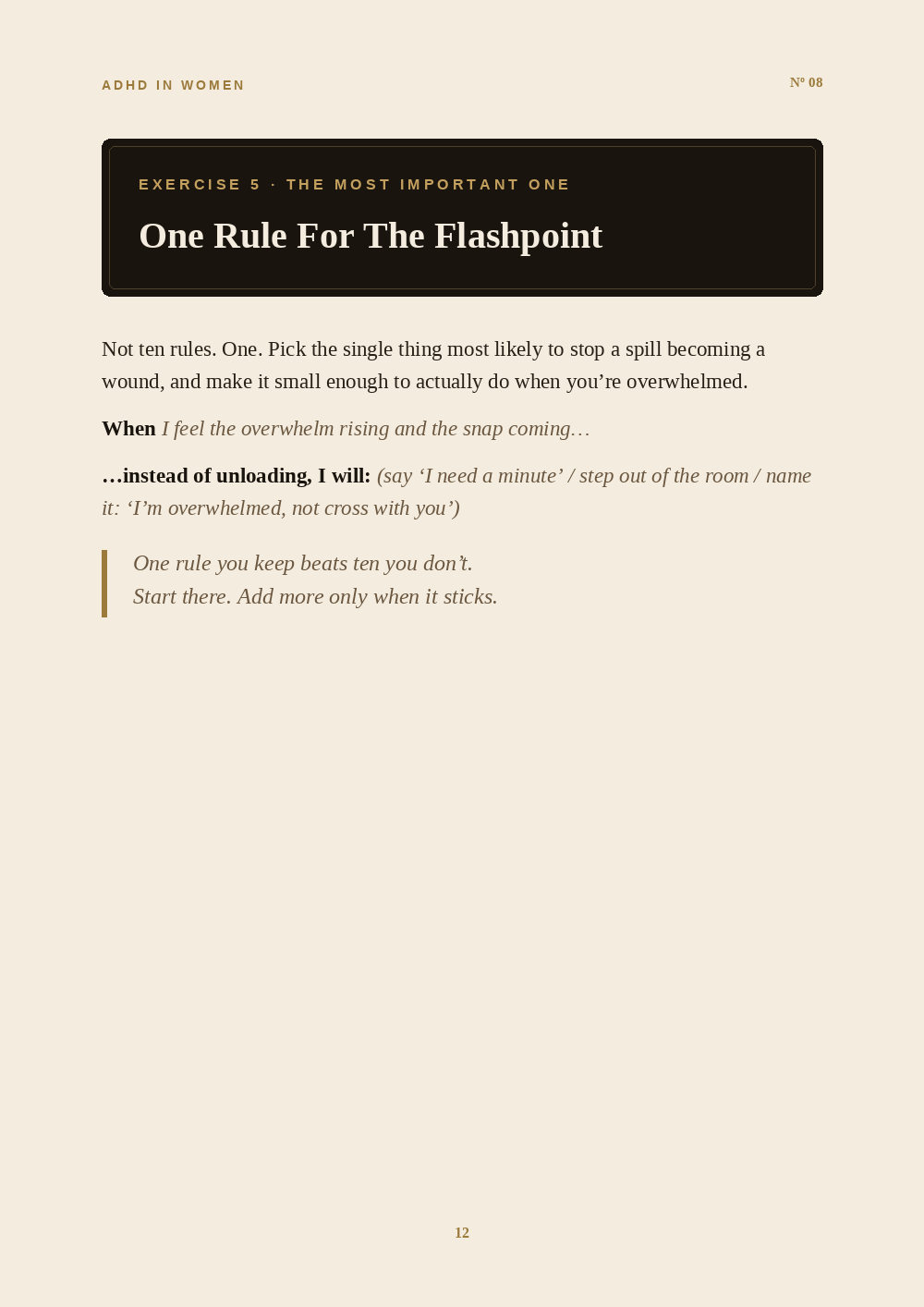
- Name it before it spills. When you feel the overwhelm rising, say it out loud: "I'm overwhelmed right now it's not about you. Give me five minutes." It buys your brain a beat, and it tells the person the storm isn't their fault.
- Take the pause, don't take it out. When the wave is too big to talk through, step away before you unload but say you're going, so it doesn't read as cold: "I need a few minutes so I don't say something I don't mean." Leaving to protect the relationship is the opposite of walking away from it.
- Explain the wiring, not excuses. An excuse says "you can't expect anything of me." An explanation says "here's what's really happening, so we can work with it together." In a calm moment, tell them plainly: "When I forget, it's not that you don't matter; my memory genuinely drops things."
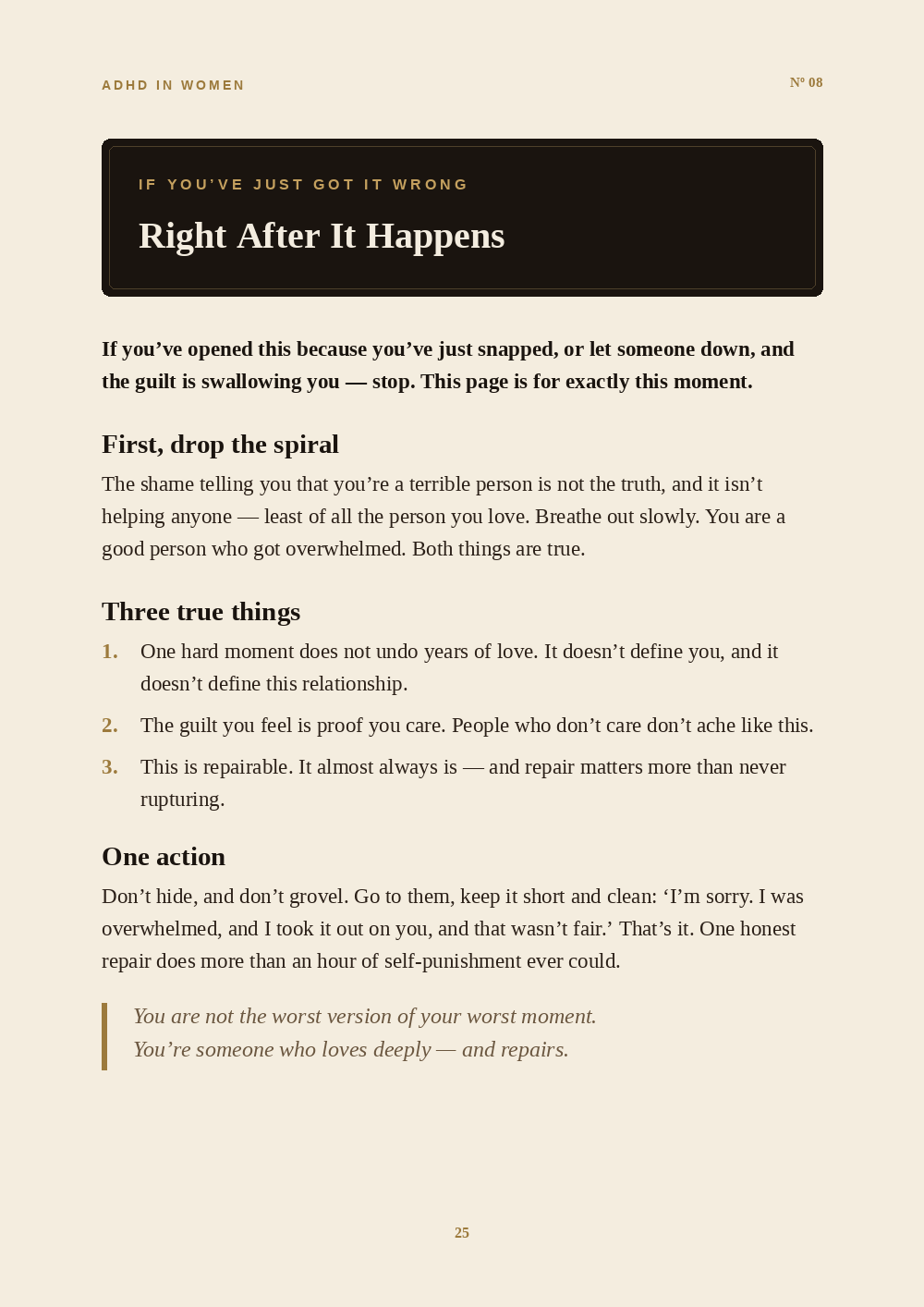
- Repair fast, and clean. You'll still get it wrong sometimes. What protects a relationship is a quick, clean repair: "I snapped and that wasn't fair I was overwhelmed, but you didn't deserve it. I'm sorry." No spiral, no ten-minute self-flagellation. Own it, mean it, move on.
- Get the load out of your head. Move appointments and the invisible mental load onto something shared a family calendar, a whiteboard, a list on the fridge so the things that matter don't live or die by an ADHD memory.
- Tell them what you need. The people who love you often want to help and simply don't know how. Hand them the manual: "Ask me one thing at a time." "If I've gone quiet, a cup of tea helps more than questions." "Text me reminders I'll find it kind, not naggy."
- Be gentle with yourself. The guilt you carry is not proof you're a bad person it's proof you care. People who don't care don't lie awake aching over a sharp word. Aim for accountability without self-punishment: own the impact, repair it, and let it go.
A gentle, important note
This is about the ordinary ways ADHD strains loving relationships. If a relationship ever leaves you feeling afraid, controlled or unsafe from either side that is not ADHD, and it's not something to manage alone. Please reach out to your GP or a specialist support service. You deserve to be safe as much as you deserve to be understood.
Where to start
Could this be ADHD?
Take my free two-minute ADHD reflection test.
Is this me? Take the free testIf reading this felt like someone was finally describing what happens between you and the people you love, the kindest next step is simply to understand what's really going on and to stop mistaking your overwhelm for a lack of love.
A good place to begin is a free, private, two-minute reflection test that helps you see your own pattern more clearly you can take it here. It won't diagnose you, but it will help you decide whether this is worth taking seriously.
And if you'd like the whole picture why your ADHD lands hardest on the people you love, and exactly how to explain and repair it I wrote a complete companion guide called How Do I Explain My ADHD To The People I Love? It goes far deeper than this article, with the scripts, the repair tools, and a clear "how to talk to your GP" section. You can explore it here →
But whatever you do next, hold onto this: you're not a bad partner, you're not a bad mother, and you were never unlovable. You're a woman whose overwhelm has been landing on the people she loves and now you have the words to explain it, and the tools to repair it.
That understanding is where everything begins.
Written by Laura, founder of ADHD in Women. This article is for educational purposes only and is not intended to replace professional medical advice, diagnosis or treatment.
Part of The Unmasked Answers Collection a growing library of practical, premium guides helping women understand ADHD, perimenopause and menopause, one question at a time.