You used to cope. Maybe not effortlessly but you held it together. The job, the kids, the birthdays, the endless mental to-do list that somehow lived in your head and never got written down. Then, somewhere in your 40s, it stopped working. The words vanish mid-sentence. You walk into rooms and forget why. You cry at adverts, snap over nothing, and lie awake at 2am quietly wondering if something is seriously wrong with your brain.
If you've typed "why did everything fall apart in my 40s" into Google at midnight, frightened and ashamed, please read this first: you are not imagining it, you are not failing, and you are very far from alone.
Something real did change. And for a huge number of women, it isn't one thing it's two things colliding at exactly the same time: undiagnosed ADHD and perimenopause. Here's what's actually happening, why it feels the way it does, and what genuinely helps.
You are not getting worse you are getting visible
The first thing to understand is that you probably didn't suddenly develop a new problem in your 40s. More often, a lifelong difference in how your brain works was finally exposed, because the two things that had been quietly holding you together stopped holding.
For most of your life, you likely ran on two hidden supports.
The first was masking the enormous, invisible effort of appearing fine. Over-preparing. Making lists. Rehearsing conversations. Working twice as hard to produce the same result as everyone else. You may have been doing this since childhood without ever knowing it had a name.
The second was oestrogen. And this is the part almost nobody explains.
Why oestrogen matters more than anyone told you
Oestrogen does far more than regulate your periods. It helps your brain produce and use dopamine the chemical behind focus, motivation, memory and mood. An ADHD brain already tends to run low on dopamine. So for years, steady oestrogen was quietly topping up a tank that was always a little empty, giving you just enough fuel to look like you were coping.
In perimenopause, oestrogen doesn't simply drop it swings, wildly and unpredictably, often for years before your periods actually stop. Some days your brain has support. Some days it doesn't. That is why you can feel like a completely different woman from one week to the next, and why the week before your period can feel like your brain has left the building.
Put it together: less hormonal fuel, plus a depleted ability to keep masking after decades of caregiving and pushing through, equals a woman who genuinely cannot do what she used to. Not because she's weak. Because the scaffolding she never knew she was standing on has come down.
You're not declining. For the first time, you're seeing what was always underneath.
For the brain-and-hormone explanation in just over four minutes, watch the free mini-class: Why Menopause Can Unmask ADHD.
"Is it ADHD or menopause?" usually, it's both
This is one of the most common searches women in their 40s make, and the honest answer is that the two are extremely difficult to separate, because they share so many symptoms: brain fog, forgetfulness, overwhelm, irritability, trouble focusing, and that maddening "tip of the tongue" word-finding.
A rough way to sort it for yourself:
- More likely the ADHD thread things that were always there, even if quieter: lifelong lateness, losing things, hating boring tasks, hyperfocus, rejection hitting you harder than it seemed to hit others, being called "bright but scattered."
- More likely the hormonal thread things that are newer: hot flushes, night sweats, new sleep problems, changing periods, brain fog that comes and goes with your cycle.
- Almost certainly both the things that were always there but got dramatically louder in your 40s: word-finding, memory slips, overwhelm, emotional reactions, motivation.
That last group is the collision. It's also why this stage of life can feel so destabilising the two are amplifying each other.
It's worth knowing how common this is. In one survey by ADDitude magazine, 94% of women with ADHD said their symptoms grew more severe during perimenopause and menopause. Not a handful. Almost all of them. If your hardest years are arriving now, you are following a very well-worn path.
Why it feels like early dementia (and why it usually isn't)
Let's name the fear most women never say out loud: what if this is early dementia?
So many women in their 40s and 50s quietly believe they're losing their minds. You forget words. You re-read the same paragraph five times. You blank on a colleague's name mid-meeting. It is genuinely frightening, and you are not dramatic for being scared.
Here's the reassuring truth. What you're describing is far more typical of ADHD colliding with hormonal change than of dementia. The difference is in the pattern. With ADHD and perimenopause, the problem is usually attention and retrieval, not loss the word isn't gone, it's on the tip of your tongue and arrives ten minutes later; the appointment wasn't forgotten forever, it just never landed because your attention was elsewhere when it was made. Your memories are intact. The under-fuelled system for grabbing them in the moment is overloaded.

Hi, I'm Laura
My ADHD was not recognised until perimenopause made everything impossible to ignore. I built ADHD in Women to give you the calm, clear support I wish I had earlier.
I know what it is to spend years coping, masking and quietly wondering why things got harder when they should have got easier.
This is not a diagnosis, and it's not a reason to ignore your health more on that below. But if a small, panicked part of you has been bracing for the worst, you're allowed to soften your shoulders a little. The most likely explanation isn't that your brain is failing. It's that your brain has been working overtime, with less fuel, for a very long time.
A personal note: I genuinely believed I was developing early dementia. I had quietly started to imagine how I'd one day tell my children. It turned out my brain was never failing it was unsupported. That experience is now echoed in thousands of messages I've read from women who were certain they were simply failing at life. Laura
Why it was never laziness
There is a particular cruelty in being called lazy when you are trying so hard it's exhausting and it's worse when the person calling you lazy is you.
Laziness is not wanting to do something and choosing not to. What you experience is the opposite: you want to do the thing, you know exactly how, it matters to you and still you cannot make yourself start. That isn't a character flaw. It's a brain that struggles to generate the "on switch" (the dopamine and executive function) that other brains get for free. Add the pressure of a task that really matters, and an already overwhelmed nervous system simply freezes.
So if you've spent years calling yourself lazy, scattered or broken, please hear this clearly: you have been doing something extraordinarily hard, for a very long time, with no help and no name for it. That is the opposite of lazy.
What actually helps
You can't fix this in an afternoon, and you don't need to. But a few changes make a real, immediate difference:
- Get it out of your head. Stop relying on memory that no longer has hormonal backup. Everything goes on paper or a phone appointments, ideas, the thing you mustn't forget.
- Work with your best hours. Notice when your brain actually shows up, and put the hard things there instead of fighting yourself at your worst time of day.
- Put one thing down. You're running on empty. Choose one task or standard you can lower or hand over this week and let the guilt be wrong.
- Track your cycle. Note your brain fog against your cycle for a few weeks. If your hardest days cluster before your period, that's not random failure it's hormonal, predictable, and you can plan gentleness around it.
- Tell one safe person. Carrying this silently makes it heavier. The right words to someone who matters can lift a weight you've held for years.
When to see your GP
Could this be ADHD?
Take my free two-minute ADHD reflection test.
Is this me? Take the free testSeveral ordinary, treatable things can also cause brain fog and memory problems and they're worth ruling out, either before you assume the worst or alongside exploring ADHD. It's reasonable to ask your GP to check your thyroid, iron (ferritin), vitamin B12 and vitamin D, to discuss perimenopause and whether HRT might help, and to look at sleep, mood and anxiety (which are often a symptom here, not the root cause).
Asking for these checks isn't being dramatic. It's being thorough about your own health and it's how you replace 2am dread with daytime answers. It's also worth saying the words out loud to your GP: "I think I might have ADHD, and I think perimenopause has made it worse." You're allowed to ask.
Where to start
If reading this felt like someone was finally describing your actual life, the kindest next step is simply to understand yourself a little better.
A good place to begin is a free, private, two-minute reflection test that helps you see your own pattern more clearly you can take it here. It won't diagnose you, but it will help you decide whether this is worth taking seriously.
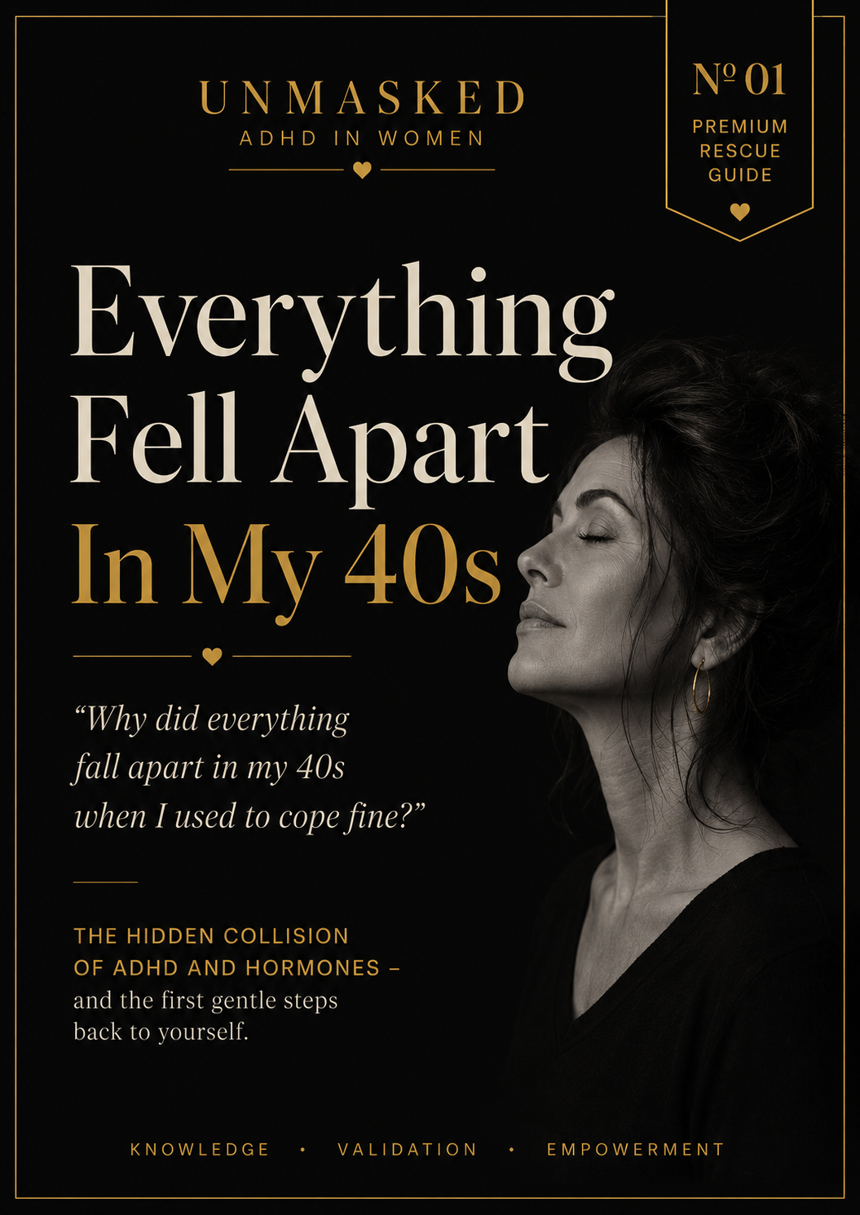
And if you'd like the whole picture why this happened, and the first gentle steps back to yourself there's a calm, practical guide written for exactly this moment, Everything Fell Apart In My 40s, part of the Unmasked System.
But whatever you do next, hold onto this: you're not too late, you're not broken, and you're not losing your mind. You're a woman whose brain and body changed, who was never given the manual and who is, right now, finally starting to understand what happened.
That understanding is where everything begins.
Written by Laura, founder of ADHD in Women. This article is for educational purposes only and is not intended to replace professional medical advice, diagnosis or treatment.
Part of The Unmasked Answers Collection a growing library of practical, premium guides helping women understand ADHD, perimenopause and menopause, one question at a time.