You get into bed and your body finally stops. Your mind doesn't. It's replaying the thing you said at 2pm, then jumping to the email you still haven't sent, then deciding your daughter's quietness on the phone must mean something is badly wrong. One worry hands you straight to the next. You're exhausted and wired at the same time, and you'd give anything for an off switch you can't seem to find.
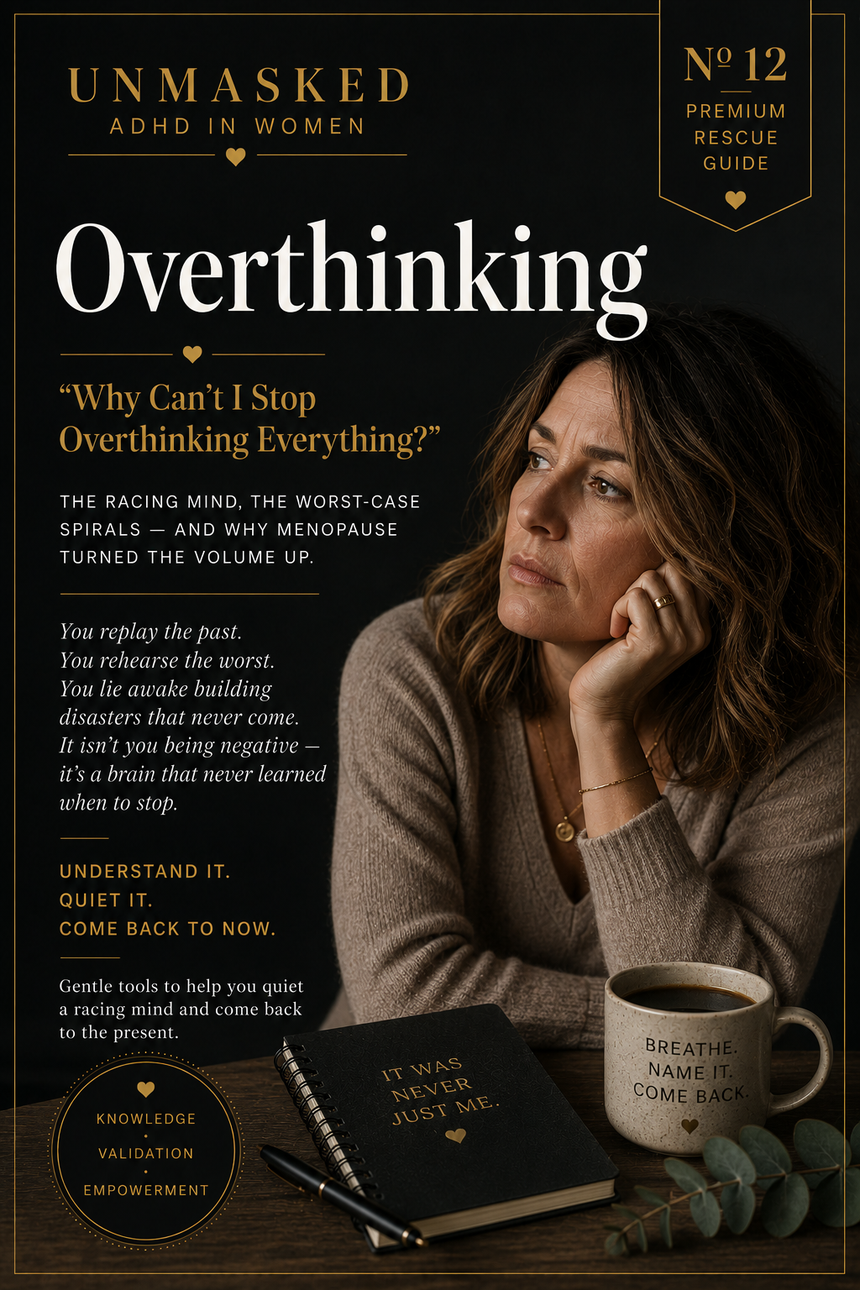
If you've ever searched "why can't I stop overthinking everything," please hear two things first: you're not doing it on purpose, and you are very far from the only one. What you're describing has a name actually two and for a woman with ADHD moving through perimenopause, there is a real, physical reason it has got so much louder lately.
It isn't one thing it's two
Overthinking runs in two directions, and most of us do both.
One looks backward. You replay what already happened the conversation, the mistake, the look someone gave you over and over, as if going round the track one more time will finally change it. That's rumination.
The other looks forward. You run the worst-case film of what might happen: if I send this, they'll hate it; if I feel this pain, it's something serious; if I forget one thing, it all falls apart. That's catastrophising.
To you it doesn't feel like two things. It feels like one exhausting fact: my brain won't stop, and it always goes to the worst place. But naming the two directions matters partly because you break each one slightly differently, and partly because it proves this is a known pattern, not a flaw in you.
Let me tell you where mine goes
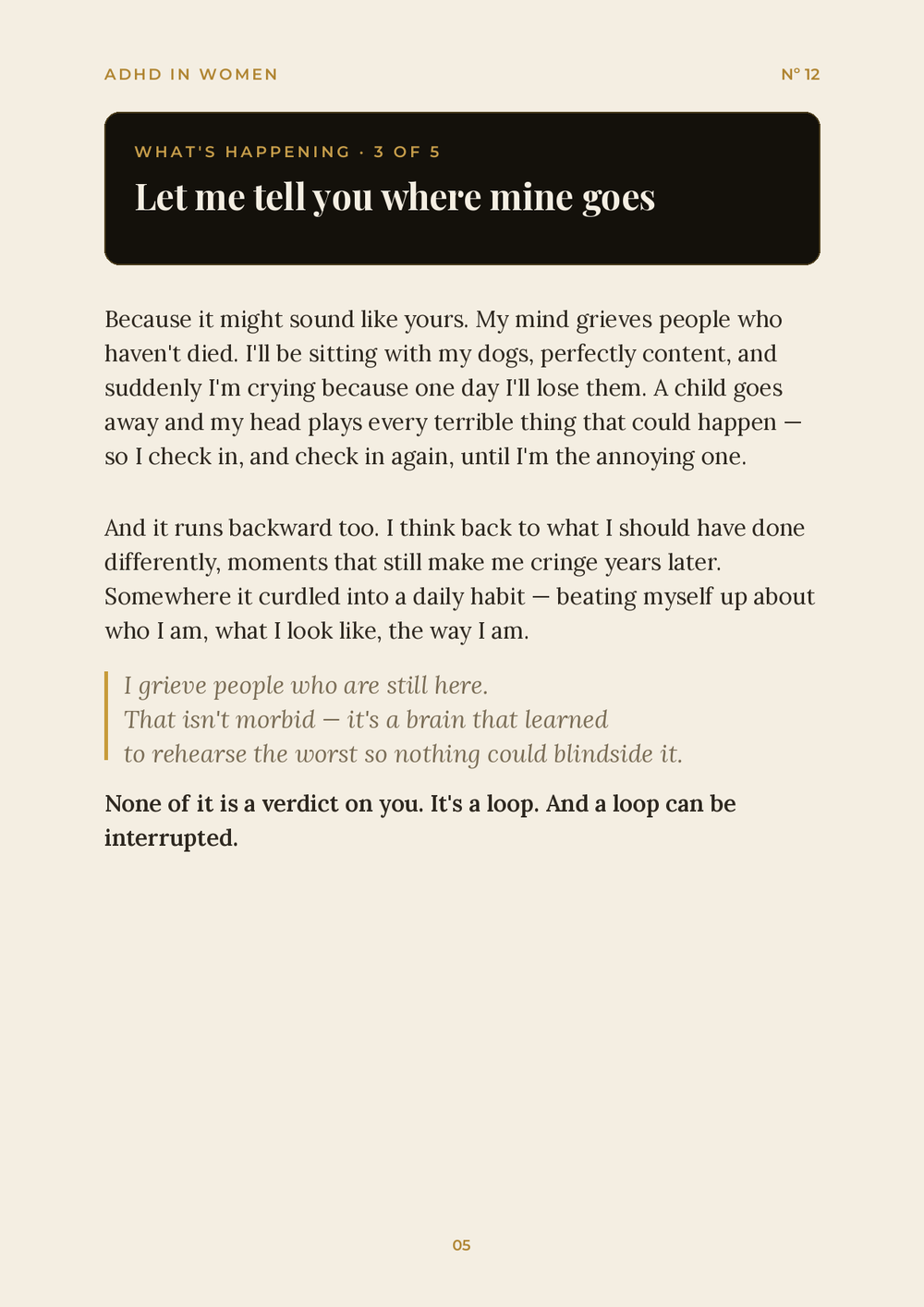
Because it might sound like yours. My mind runs forward, and it grieves people who haven't died. I'll be sitting with my dogs, perfectly content, and suddenly I'm crying because one day I'll lose them. One of my kids goes away and my head plays me every terrible thing that could happen to them — so I "check in," and check in again, until I'm the one being annoying. I'd protect them at all costs from things that haven't happened and probably never will. It isn't that I love too much. It's that my brain decided long ago that if it braces for the loss now, it can't be caught off guard later.
And it runs backward too. I think back to things I should have done differently, moments that still make me cringe years later. Somewhere along the way that curdled into a daily habit — beating myself up about who I am, what I look like, the way I am. Not now and then. Daily.
I grieve people who are still here. That isn't being morbid — it's a brain that learned to rehearse the worst so nothing could blindside it.
If any of that landed a little too close, hold onto the same thing I had to learn: none of it is a verdict on you. It's a loop. And a loop can be interrupted.
Why an ADHD brain does this
Here's the part no one tells you: overthinking isn't a sign you're weak, or negative, or dramatic. It's what an ADHD brain does when a few things line up.
An ADHD brain struggles to let go. Once a thought hooks you, disengaging from it is genuinely hard it's the same wiring that makes it hard to pull out of a good hyperfocus, only pointed at something painful.
Your feelings arrive louder. ADHD comes with big, fast emotions, so there's more fuel keeping the loop spinning. A small worry doesn't get to stay small.
And your working memory won't hold the reassurance. "It was fine last time" doesn't stick, so every worry feels brand new and every bit of comfort leaks straight back out. That's why talking yourself down works for ten minutes and then the same thought is back at the door.
Put those together and you get a mind that latches on, turns the volume up, and can't file the thing away as dealt with. Round it goes.
I beat myself up daily — about who I am, what I look like, the way I am. That isn't the truth about me. It's a loop I was never taught how to switch off.
Why menopause turned the volume up
Here's the question that haunts so many women: "Why has this got so much worse in my forties almost overnight?" You are not imagining it, and it isn't just you becoming an anxious person in midlife.
In perimenopause, oestrogen doesn't gently fade. It spikes and crashes, sometimes wildly, from one week to the next. And oestrogen isn't only a reproductive hormone it helps your brain make and use dopamine and serotonin, the very chemicals that steady your mood and help you regulate your emotions.
So as oestrogen swings and drops, so do they. The brakes on your thinking get weaker at exactly the moment your ADHD brain needs them most. Women who never had a moment's anxiety in their lives suddenly find themselves lying awake worst-casing at 4am. And for those of us who were already prone to it, the loop that used to be a background hum becomes a roar.
You didn't suddenly turn into an anxious person. Your brain lost some of the fuel it used to keep the overthinking in check.

Hi, I'm Laura
My ADHD wasn't recognised until perimenopause made everything impossible to ignore including a mind that would not stop.
I built ADHD in Women to give you the calm, clear support I wish someone had handed me years earlier.
Why "just think positive" never works
You've been told to look on the bright side more times than you can count, and it has never once helped. Here's why and it isn't a failing on your part.
To a tired, depleted, braced brain, positive thinking feels unsafe. If some part of you learned that expecting the worst meant you were never caught off guard, then optimism feels like dropping your guard like inviting the bad thing in. Your system quietly refuses it.
And you cannot think your way out of a chemical dip by willpower. When the fuel is low, "just choose better thoughts" is like being told to drive faster on an empty tank. It isn't that you won't. It's that the tank is empty. So please stop adding "and I can't even think positive" to the pile that was never the fix.
When it stops being thoughts and becomes panic
Sometimes it doesn't stay in your head. You get the pounding heart, the tight chest, the pit in your stomach over something that hasn't even happened. You wake at 4am certain something is wrong, with no reason you can actually name.
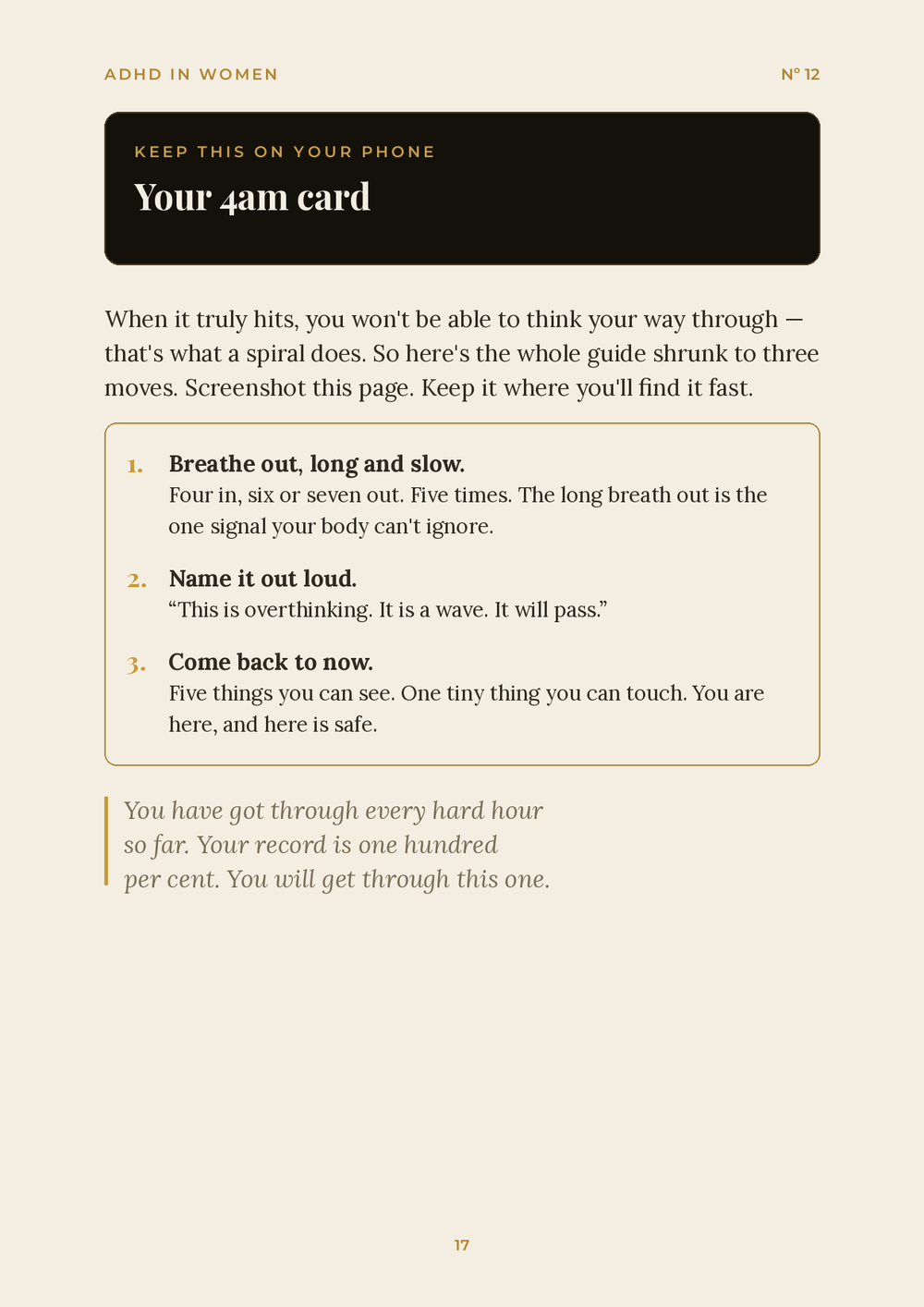
This makes sense once you know one thing: your body can't tell the difference between a vivid thought and a real event. Imagine the disaster clearly enough and your nervous system fires the real fear, adrenaline and all, for a threat that only exists in your mind. You're not overreacting. You're having a genuine physical response to an imagined future. The fear is real. The threat, almost always, is not.
Could this be ADHD?
Take my free two-minute ADHD reflection test.
Is this me? Take the free testHow to actually quiet it seven gentle ways
You can't force a loop to stop, but you can interrupt it. These work with an ADHD brain instead of against it.
- Name which one it is. Out loud if you can: "this is rumination" or "this is catastrophising." Naming pulls it out of feeling like the truth and shows it for what it is a loop. You did the powerful bit the moment you learned the words.
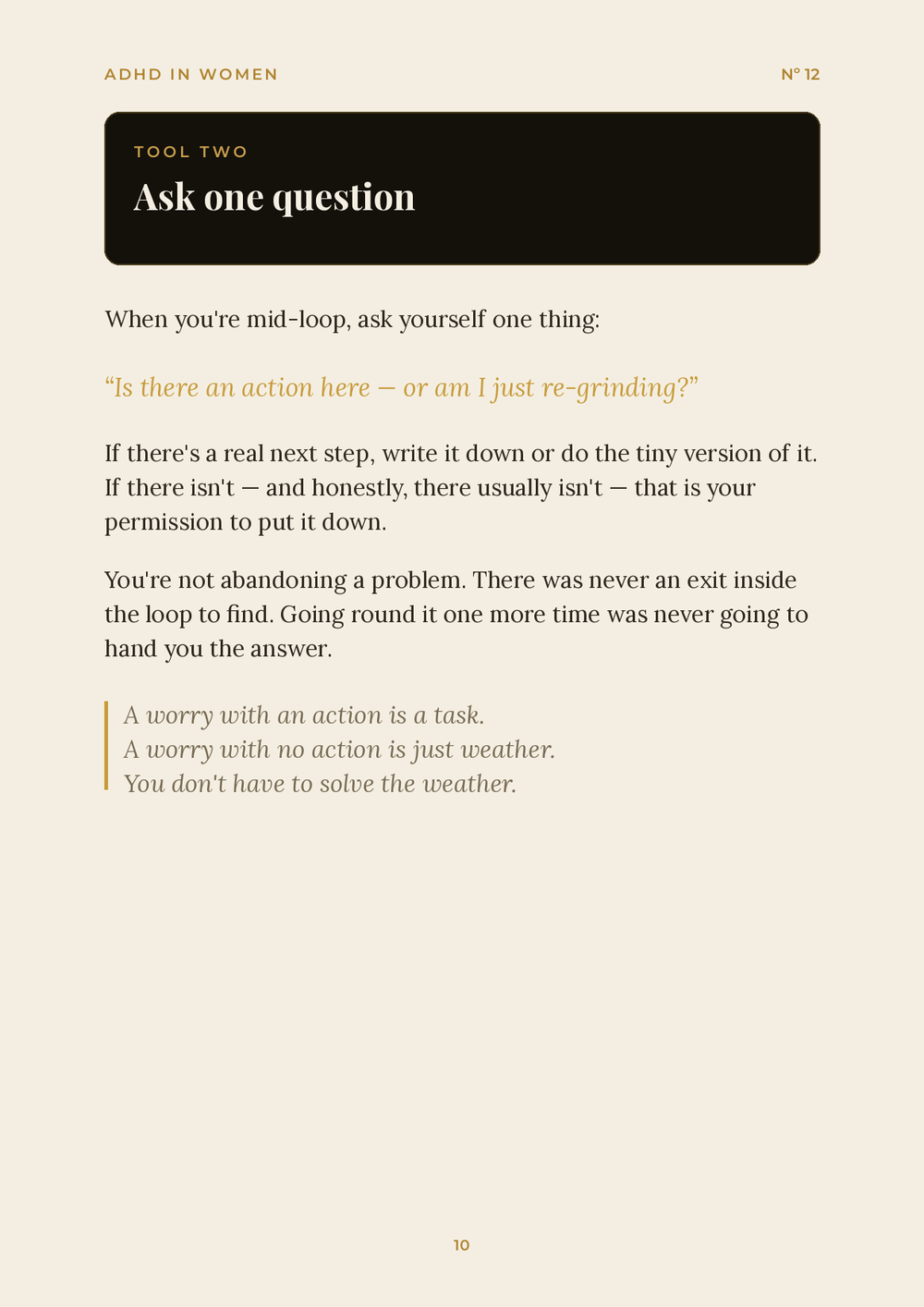
- Ask one question: is there an action here, or am I just re-grinding? If there's a real next step, write it down or do the tiny version. If there isn't and usually there isn't that's your permission to put it down. You're not abandoning a problem; there was never an exit inside the loop to find.
- Run all three endings, not just the worst. Your brain shows you the disaster and stops there. Make it finish the job: what's the worst case, what's the best case, and honestly what's the most likely? The likely one is nearly always survivable.
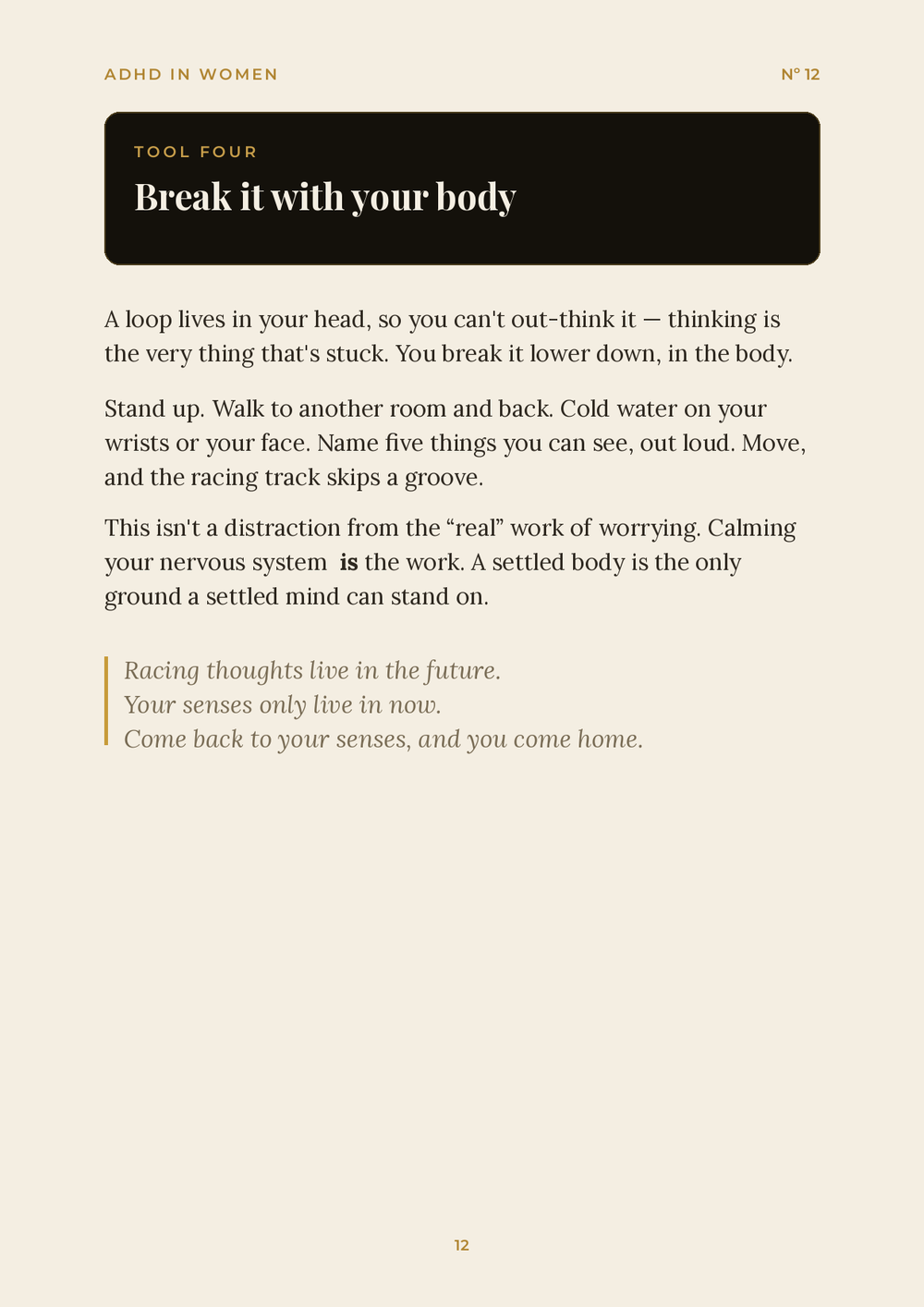
- Break it with your body. A loop lives in your head, so you can't out-think it. Stand up, walk to another room, cold water on your wrists, name five things you can see. Change your physical state and the track skips.
- Give worry a window. Instead of all day, book it ten minutes: "I'll worry at 6pm." When a thought comes early, tell it there's an appointment. It sounds daft, and it genuinely works your brain stops fighting to hold the thought once it trusts it'll get its turn.
- Get it out of your head and onto paper. A worry in your mind feels infinite. The same worry on a page is just a line you can look at. Empty it out don't solve it, just pour it out and your brain can finally stop gripping.
- Talk to yourself like someone you love. You would never say "what is wrong with you" to a friend who was struggling. Stop rehearsing it at yourself it pours petrol on the fire every single time.
What helps me now
I haven't switched the loop off — I'm not sure anyone fully does. But I've learned to catch it. When I feel myself spiralling, I look at how happy my dogs are and I think: I did that. That one thought — a bit of pride, right here in the present — stops it in its tracks.
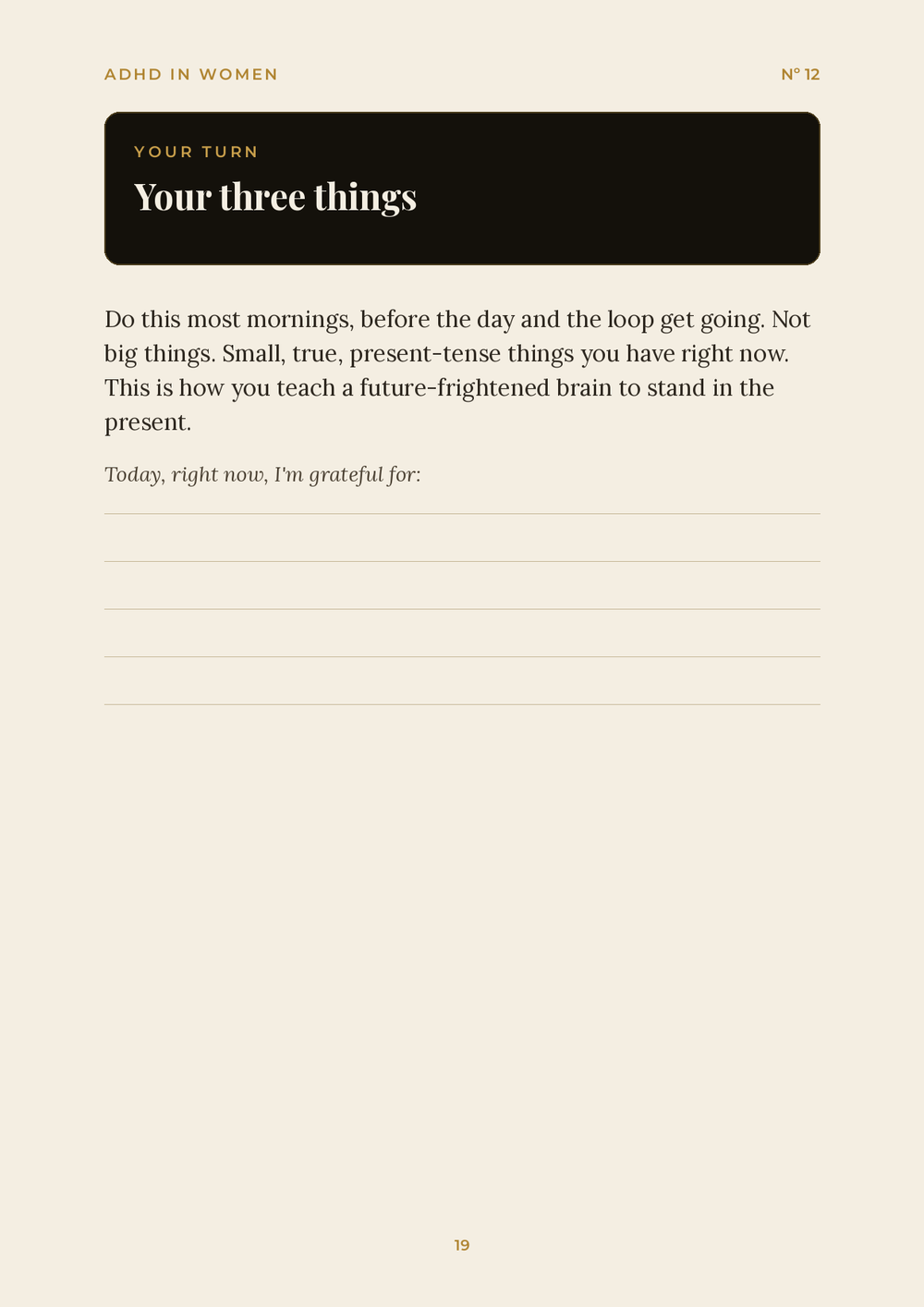
And most mornings I get up and name three things I have right now, in the present, that I'm grateful for. I've lost a lot in my life. I can't change the past, and I can't argue my brain out of its worst-casing. But I can keep turning towards the present, one small day at a time. If I could sit beside you at 4am, that's what I'd say: you are a unique person, you can't change the past or the fear you carry — but you can face the future, and you can start with three good things that are true right now.
And maybe the biggest relief is the smallest thing: there's a word for what you do. Which means you were never the only one. There are so many of us. It was never just you.
When it might be more than overthinking
Overthinking and everyday anxiety respond to the tools above. But it's worth gently speaking to your GP if the worry is constant rather than coming in waves, if you're having full panic attacks, if you wake most nights in dread, if you feel persistently low or hopeless, or if daily life is genuinely slipping. That isn't weakness it's information, and there is real help, including for the hormonal side. Menopause-aware support can change this more than you'd expect.
Where to start
If reading this felt like someone was finally describing the inside of your own head, the kindest next step is simply to understand your brain a little better.
A good place to begin is a free, private, two-minute reflection test that helps you see your own pattern more clearly you can take it here. It won't diagnose you, but it will help you decide whether this is worth taking seriously.
And if you'd like the whole picture why your mind does this, why menopause made it louder, and the calm tools that actually quiet it I wrote a complete companion guide called Why Can't I Stop Overthinking Everything? It goes far deeper than this article, with exercises and gentle scripts for the 4am spirals. You can explore it here.
But whatever you do next, hold onto this: you were never negative, and you were never too much. You have a brain that loved you enough to try to keep you safe it just never learned when to stop.
That understanding is where the quiet begins.
Written by Laura, founder of ADHD in Women. This article is for educational purposes only and is not intended to replace professional medical advice, diagnosis or treatment.
Part of The Unmasked Answers Collection a growing library of practical, premium guides helping women understand ADHD, perimenopause and menopause, one question at a time.