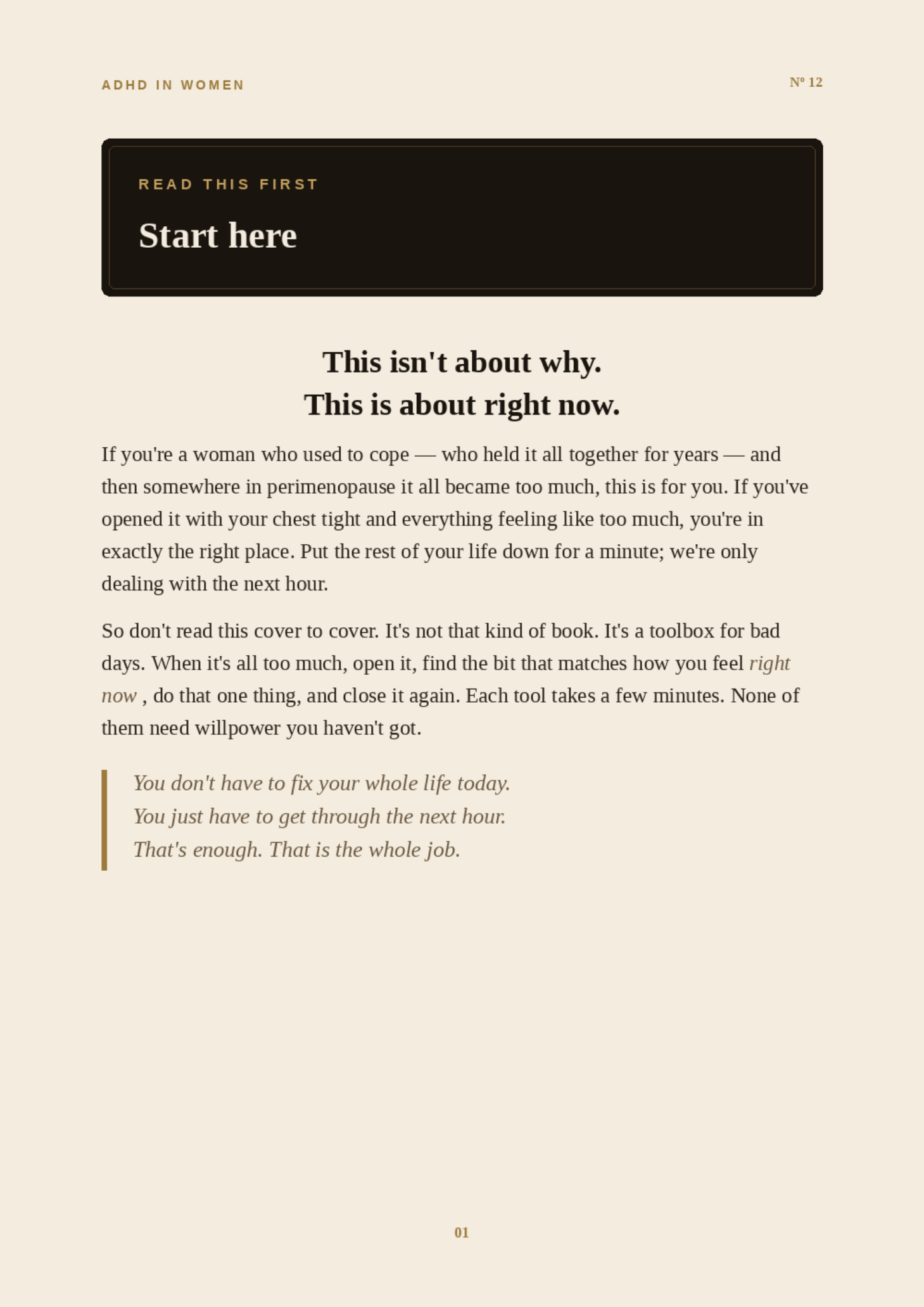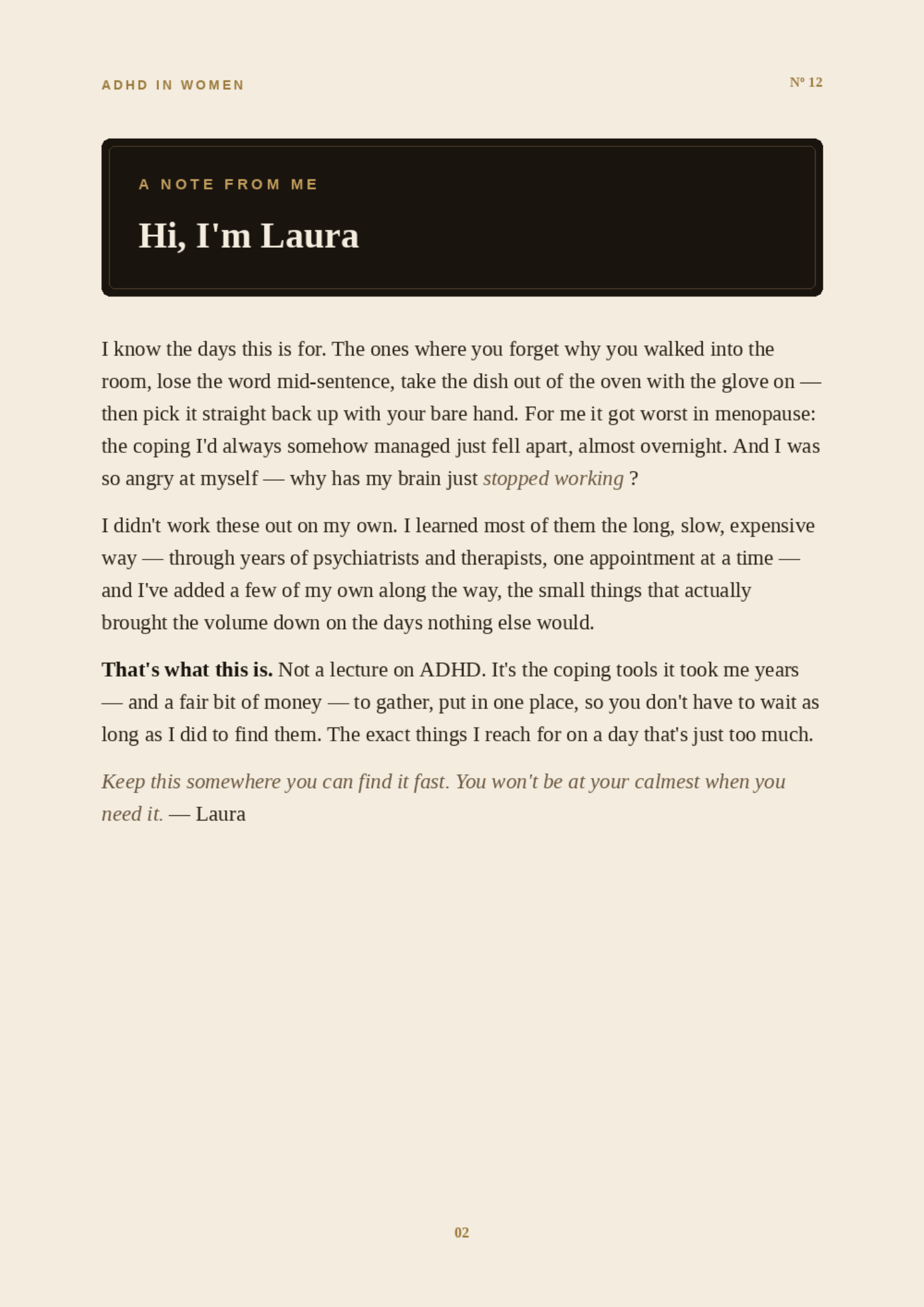
Some days, it's all simply too much. You forget why you walked into the room. You lose the word mid-sentence. You take the dish out of the oven with the glove on then pull the glove off and pick it straight back up with your bare hand. And underneath it all is that furious, frightened question: why has my brain just stopped working?
If you're a woman who used to cope who held it together for years and then somewhere in perimenopause it all became too much, please hear this first: you are not falling apart as a person. Your brain lost the support it was quietly running on, and no one warned you it was coming. This isn't about understanding why today (that can wait). Right now, you just need to get through it. So here are the calm, in-the-moment tools that actually help none of which need willpower you haven't got.
Why it all gets so much louder in menopause
Here's the part almost nobody explains. Oestrogen doesn't just belong to your periods it helps power dopamine and serotonin, the exact brain chemicals an ADHD brain already runs short on. Through perimenopause and menopause, those hormones start to swing and fall away. So the scaffolding you'd leaned on your whole life, the coping you never even noticed you were doing, quietly gives way. The overwhelm, the fog, the forgetting, the tears from nowhere they got louder because your brain lost its support, not because you got weaker. That reframe matters, because you can't fix a hormone problem with more self-discipline.
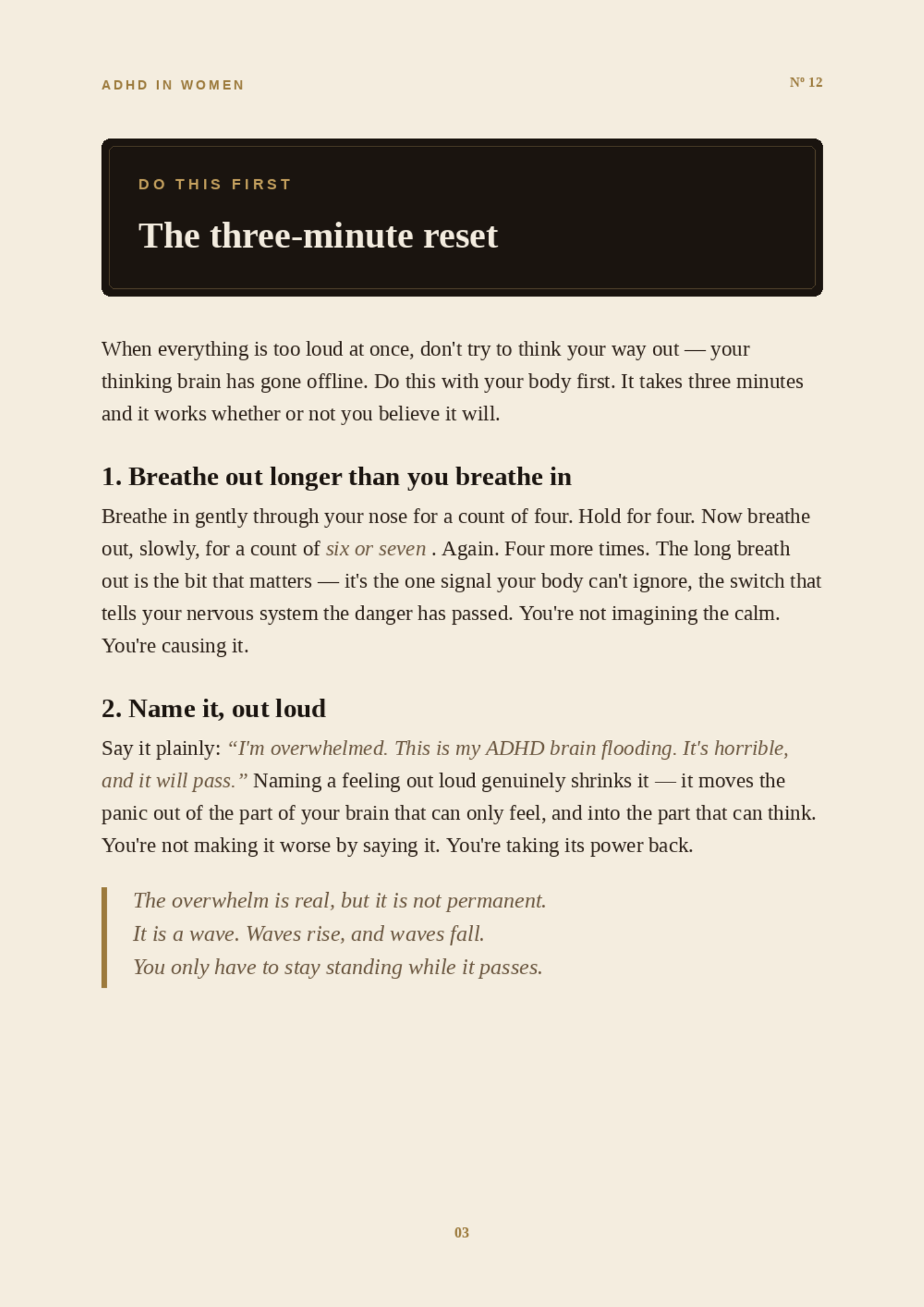
When it's all too much: the three-minute reset
When everything is too loud at once, don't try to think your way out your thinking brain has gone offline. Go to your body first.
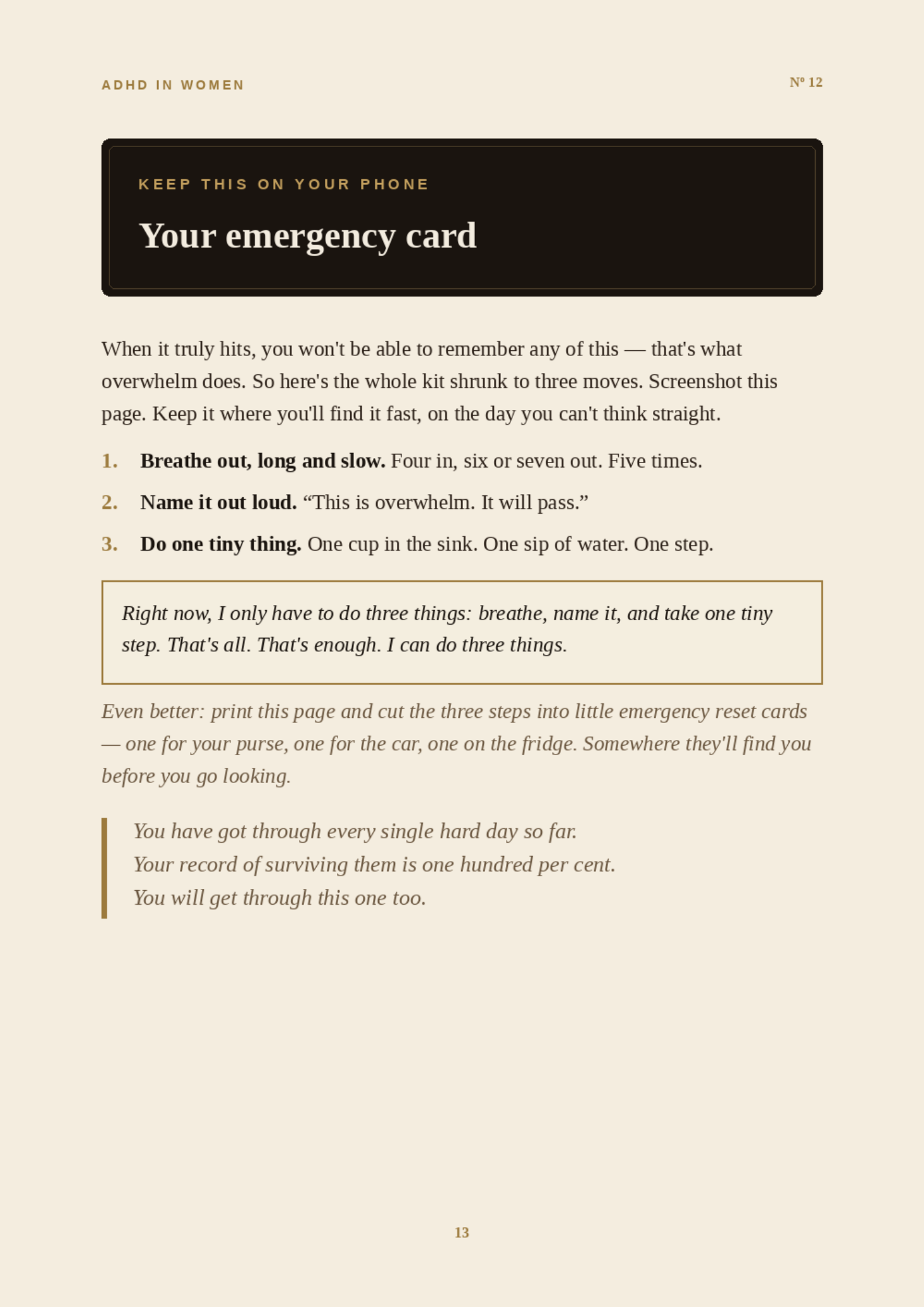
Breathe out longer than you breathe in. In through your nose for a count of four. Hold for four. Then breathe out, slowly, for a count of six or seven. Four more times. The long exhale is the bit that matters it's the one signal your body can't ignore, the switch that tells your nervous system the danger has passed. You're not imagining the calm; you're causing it.
Then name it, out loud. "I'm overwhelmed. This is my ADHD brain flooding. It's horrible, and it will pass." Naming a feeling genuinely shrinks it it moves the panic out of the part of your brain that can only feel, into the part that can think.
When your head is spinning: come back to the room
If your thoughts are racing and you can't catch them, name five things you can see, four you can hear, three you can touch, two you can smell, and one slow breath out. Racing thoughts live in the future; your senses only live in now. This drags you back to now where the danger isn't.
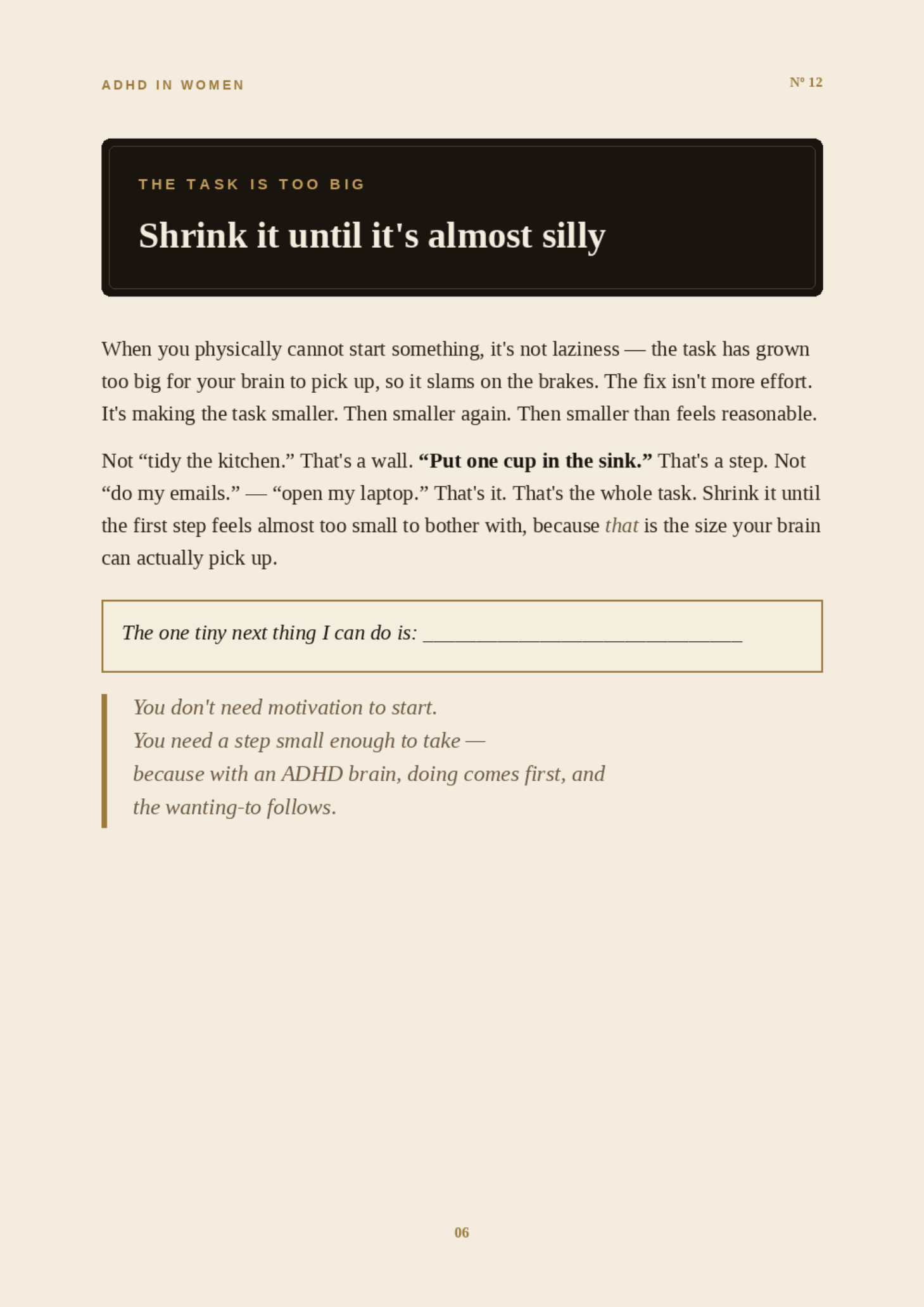
When you can't start: shrink it until it's almost silly
Task paralysis isn't laziness. The task has grown too big for your brain to pick up, so it slams on the brakes. So make it smaller. Not "tidy the kitchen" "put one cup in the sink." Not "do the emails" "open the laptop." Shrink the first step until it feels almost too small to bother with, because that's the size your brain can actually lift. And if you're frozen, set a ten-minute timer (you're allowed to stop when it goes), or do it beside someone body-doubling, even a friend scrolling their phone next to you, is one of the most reliable ADHD tools there is.

Hi, I'm Laura
My ADHD was not recognised until perimenopause made everything impossible to ignore. I built ADHD in Women to give you the calm, clear support I wish I had earlier.
I know what it is to spend years coping, masking and quietly wondering why things got harder when they should have got easier.
When the feelings are too big: ride the wave
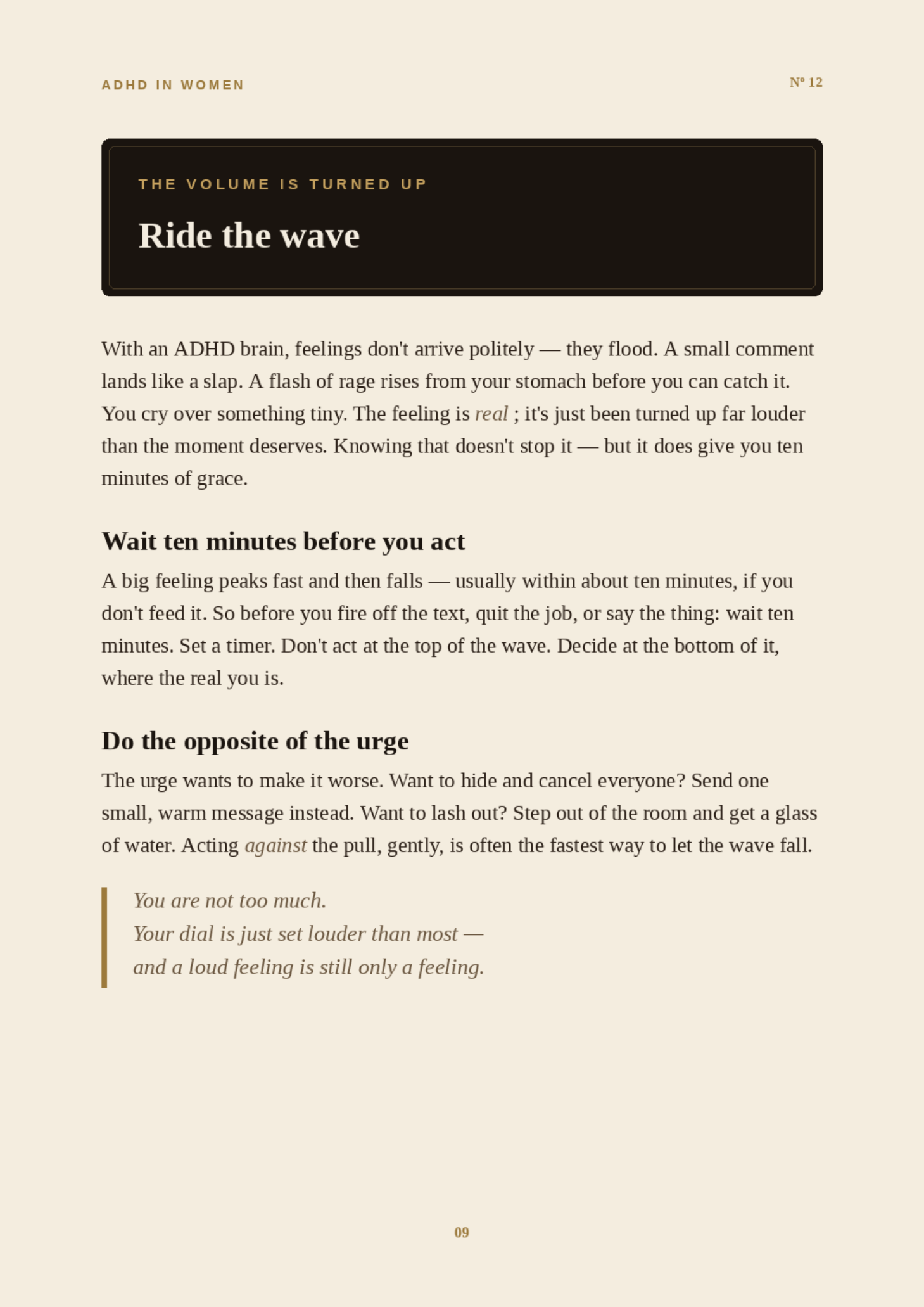
With an ADHD brain, feelings don't arrive politely they flood. A small comment lands like a slap; rage rises before you can catch it; you cry over something tiny. The feeling is real, it's just turned up far louder than the moment deserves. So before you fire off the text or say the thing, wait ten minutes a big feeling peaks and falls fast if you don't feed it. Decide at the bottom of the wave, not the top. And be kind to yourself while it passes; the cruel inner voice pours petrol on the fire every single time.
Where to start
If any of this felt like someone finally describing your worst days, the gentlest next step is simply to understand your own brain a little better and to stop calling yourself lazy or broken for something your body was never set up to find easy.
A good place to begin is a free, private, two-minute reflection test you can take it here. It won't diagnose you, but it'll help you decide whether this is worth taking seriously.
Could this be ADHD?
Take my free two-minute ADHD reflection test.
Is this me? Take the free testFree article: How Do I Get Through Today? Paid companion product: The ADHD Overwhelm Rescue Kit. It is an immediate 26-page digital toolkit for women whose overwhelm, brain fog and emotional flooding became impossible to ignore during perimenopause or menopause. GET THE ADHD OVERWHELM RESCUE KIT — £12
Whatever you do next, hold onto this: the bad days will still come that's not failure, that's a brain and a body doing something hard. But now you have a way through them. Not a cure. A hand to hold on the days it's all too much.
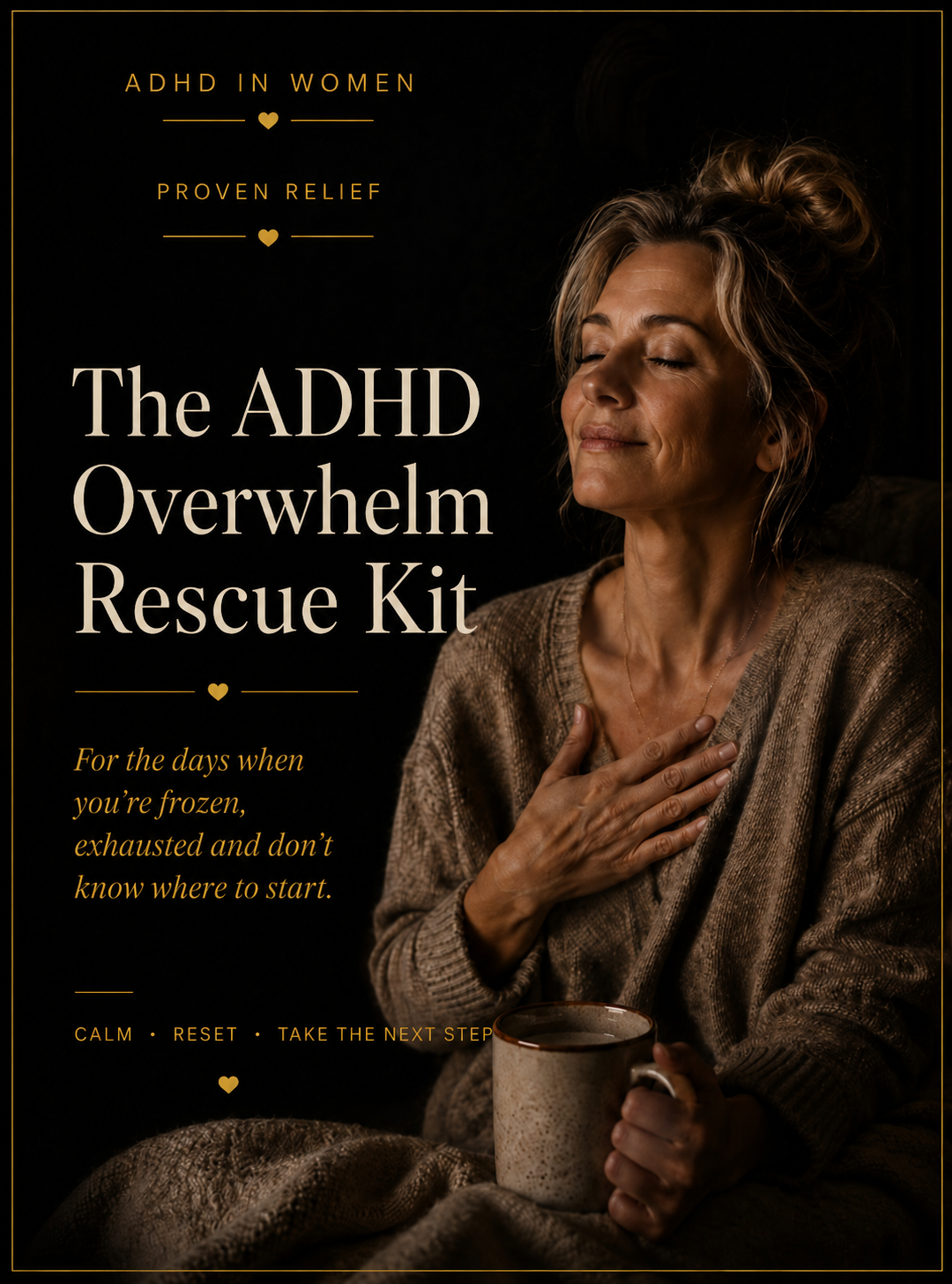
The ADHD Overwhelm Rescue Kit
For women whose brain suddenly became harder to manage during perimenopause or menopause. An immediate 26-page digital toolkit for women whose overwhelm, brain fog and emotional flooding became impossible to ignore during perimenopause or menopause.
GET THE ADHD OVERWHELM RESCUE KIT — £12Written by Laura, founder of ADHD in Women. This article offers general coping tools for education and support only it is not medical advice or therapy. If you ever feel you can't keep yourself safe, please reach out; in the UK the Samaritans are there day or night, free, on 116 123.
Part of The Unmasked Answers Collection a growing library of practical, premium guides helping women understand ADHD, perimenopause and menopause, one question at a time.