Some weeks you are on top of it. You reply to the messages. You start the thing you have been putting off. You feel almost normal.
Then, without warning, it goes. The fog rolls in. You cannot start anything. Small things floor you. You snap at the people you love and cry over things that shouldn't matter. And you think: what is wrong with me? Why can't I just be consistent?
For years I thought I was unreliable. Two different women in one body, and I never knew which one I'd wake up as. Now I know I was never unreliable. I was cyclical. And the day someone finally explained it to me, everything made sense.
The one thing no one tells you
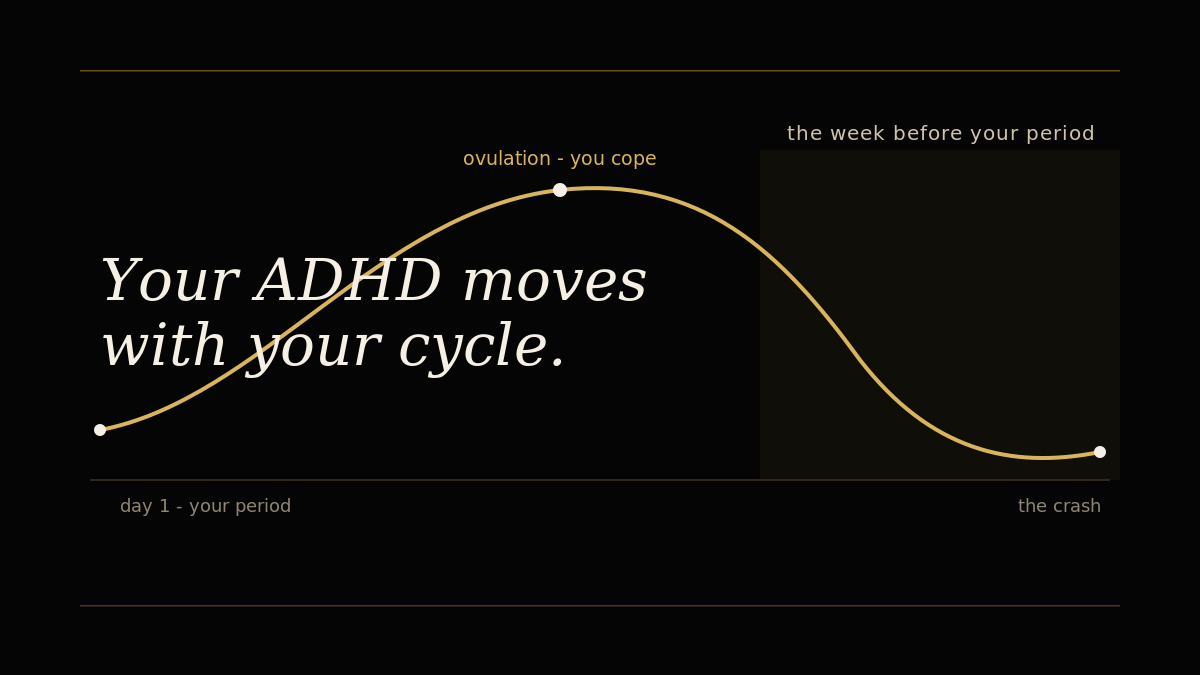
Your ADHD is not the same every day. It moves with your hormones - and your hormones move on a monthly loop.
Here is the part almost no one explains in plain English: oestrogen helps your brain make and use dopamine. Dopamine is the exact chemical the ADHD brain is already short of - the one behind focus, motivation and feeling steady.
So when oestrogen rises, your ADHD eases. When oestrogen falls, your ADHD gets louder. Every single month. It was never about willpower. It was chemistry you couldn't see.
Your month, phase by phase
Every cycle is different, and the days below are a rough guide, not a rule. But the shape of it is the same for a lot of us.
Your period - roughly days 1 to 5
Oestrogen is at its lowest, but it has just started to climb again. For many women this is when the fog begins to lift - like a window opening after a stuffy room. You may still be tired, but your head feels a little clearer than the week before.
The good weeks - roughly days 6 to 14
Oestrogen climbs to its peak around ovulation. This is often the best your brain feels all month. Focus comes easier. You start things. You feel capable, calmer, more like the woman you think you should be all the time.
One quiet warning: this is where we over-promise. We say yes to everything, fill the diary, start five projects - because right now, we can. Be kind to the version of you two weeks from now who has to carry all of it.
The drop - roughly days 15 to 28, the luteal phase
After ovulation, oestrogen falls and progesterone rises. Dopamine falls with the oestrogen, and the progesterone dulls it further. This is the shift you always felt but could never name: the focus goes, starting anything feels impossible, everything is too much, and your emotions sit right at the surface.
If one comment can ruin your whole day this week - this is why.
The week before your period - the hardest days
In the last few days, oestrogen bottoms out. For many women this is when ADHD feels at its most severe. And if you take medication, this is the week it can feel like it has simply stopped working.

Hi, I'm Laura
My ADHD was not recognised until perimenopause made everything impossible to ignore. I built ADHD in Women to give you the calm, clear support I wish I had earlier.
I know what it is to spend years coping, masking and quietly wondering why things got harder when they should have got easier.
That is not in your head. Research suggests that in this phase, symptoms can look like those of a woman not taking medication at all - even when she is.
For some women it goes further than ordinary PMS. When the low mood, the rage and the despair each month become overwhelming, that can be PMDD - premenstrual dysphoric disorder - and it turns up far more often in women with ADHD than in women without it. If that sounds like you, it is worth raising with your GP. You are not being dramatic.
Why this matters even more after 40
In perimenopause, this monthly loop stops being predictable. Cycles get shorter, then longer, then heavier, then skipped. Oestrogen no longer just dips and recovers - it swings, and overall it is trending down.
So the pattern you are only just learning to read gets scrambled. The hard weeks can hit harder and last longer, and the good weeks can go missing for a while. If it feels like the ground keeps moving under you, that is why. There is more on that here: ADHD and hormones after 40.
So what does this actually change?
You are not unreliable. You are not two different people. You are one woman on a hormonal tide that nobody ever explained to you.
Could this be ADHD?
Take my free two-minute ADHD reflection test.
Is this me? Take the free testAnd here is the part that changes everything: a pattern you can see is a pattern you can work with.
- Front-load the hard, important things into your good weeks, on purpose.
- Protect the luteal week. Lower the bar. Fewer commitments, more rest, and no big decisions if you can avoid them.
- Stop reading the bad week as proof you are failing. It is a phase. It passes. It always passes.
- If the premenstrual crash is severe, take it to your GP. There are real options, and you deserve to be heard.
None of this is about fixing yourself. There is nothing to fix. It is about stopping the fight against a body that was never working against you - it was just working on a rhythm no one taught you to read.
See your own pattern
The hardest part is that you cannot manage a pattern you cannot see. When it is all in your head, every bad week feels like the first - like proof that this is simply who you are now.
So stop guessing. Start seeing it.
I built a free, private cycle tracker for exactly this. A few taps a day, and over a few weeks your own pattern appears on the screen - the fog, the overwhelm and the lost focus rising and falling with your hormones. Nothing to buy. Nobody sees it but you.
Once you can see it, you can finally stop blaming yourself - and start planning around it.